Psalm 139
This popular psalm is attributed to David. We do not know when this was written and in what context. All we can say is that this psalm was written by an intelligent man, thinking about the meaning of life and God. He is aware of the hard realities of life. He is also aware of the intimate relationship he has with his God. This psalm can be divided into 5 parts.
A. The Omniscience of God (v.1-6)
You have “examined” or “scutinized” me. God knows me very well. No need to hide or wear our masks. We are become our real self when we are with Him. No need to hide behind masks, No need to pretend to be someone I am not.
God knows my outward action: sit (rest); rise (action, work) and also my inward action: my hidden life; emotional; thinking. He knows what I am able to do because He knows me so well.
God knows my needs better than I do. That is why He hems me in – He is providing close guard or protection for me. He knows what danger I can get myself into if I am allowed to wander along on my own. He blesses my by His laying on of hands.
The Lord knows us through and through. This can be a terrifying thought. It is also a reassuring thought. So let your hair down and be who you are; God knows who you are anyway.
B. The Omnipresence of God (v.7-12)
Spirit and presence speaks of the total presence of God. There is no where I can go where I am out of reach of God. The psalmist uses the vertical reaches of heaven and hell. God is there in heaven. Even in hell, God is there. There is no realm that is outside His domain. From the rising of the sun in the east of the Mediterranean Sea to its setting in the west is the psalmist’s way of saying that in the entire known world, God is present.
C. The Omnipotence of God (v.13-18)
God is also omnipotent. We are fearfully and wonderfully made. I can appreciate the complexity of the human body and mind as a doctor. We are indeed fearfully and wonderfully made. What is more reassuring is that God knows me even before the foundations of creation was laid. He knows of when I am being formed and all the things I will do and be, even before I am born. It is a powerful reminder to me that in spite of what God knows about me, He still loves me.
D. The Enemies of God (v. 19-22)
Suddenly there is a change in the tempo. The psalmist started by telling about the omniscience, the omnipresence and omnipotence of God. Suddenly he changed and talked about the enemies of God. There are some commentators who believed that this section was added on later. I do not believe so. I believe it is a part of this wonderful psalm. The psalmist was telling about his own experience of the omniscience, omnipresence and omnipotence of God. Then he told of people who strayed away from God, people who rejected God and people who hated God. He then stated that he will hate these types of people. There is always a danger of categorizing people as “them and us.” Did he not earlier say how God loves people? Is there not a hint of self-righteousness in his statement. “I am not like that so I can hate them”. A better approach will be “there but for the grace of God, goes I.” I need to have this awareness on how easy I can sin and turn away from God, how easy for me to become “them.”
E. The Way Everlasting (v.23-24)
I believe it is precisely that awareness of our fallen-ness in the presence of the omniscience, omnipresence and omnipotence God that the psalmist ends by asking God to seek his heart and dig out the sinful parts. Compared to the beginning where he said that God had searched his heart. We need to be continually searching our lives and motives so that we are aligned with the path of God. The psalmist ended with being led on the way everlasting. The words “way everlasting” appears only once in the Old Testament and it is here. It indicates our journey from the past to the present and onto the future. To walk with this Great Almighty God, I must walk the path of righteousness.
So help me, God.
Amen
Friday, October 6, 2006


The Way Everlasting
Psalm 139
This popular psalm is attributed to David. We do not know when this was written and in what context. All we can say is that this psalm was written by an intelligent man, thinking about the meaning of life and God. He is aware of the hard realities of life. He is also aware of the intimate relationship he has with his God. This psalm can be divided into 5 parts.
A. The Omniscience of God (v.1-6)
You have “examined” or “scutinized” me. God knows me very well. No need to hide or wear our masks. We are become our real self when we are with Him. No need to hide behind masks, No need to pretend to be someone I am not.
God knows my outward action: sit (rest); rise (action, work) and also my inward action: my hidden life; emotional; thinking. He knows what I am able to do because He knows me so well.
God knows my needs better than I do. That is why He hems me in – He is providing close guard or protection for me. He knows what danger I can get myself into if I am allowed to wander along on my own. He blesses my by His laying on of hands.
The Lord knows us through and through. This can be a terrifying thought. It is also a reassuring thought. So let your hair down and be who you are; God knows who you are anyway.
B. The Omnipresence of God (v.7-12)
Spirit and presence speaks of the total presence of God. There is no where I can go where I am out of reach of God. The psalmist uses the vertical reaches of heaven and hell. God is there in heaven. Even in hell, God is there. There is no realm that is outside His domain. From the rising of the sun in the east of the Mediterranean Sea to its setting in the west is the psalmist’s way of saying that in the entire known world, God is present.
C. The Omnipotence of God (v.13-18)
God is also omnipotent. We are fearfully and wonderfully made. I can appreciate the complexity of the human body and mind as a doctor. We are indeed fearfully and wonderfully made. What is more reassuring is that God knows me even before the foundations of creation was laid. He knows of when I am being formed and all the things I will do and be, even before I am born. It is a powerful reminder to me that in spite of what God knows about me, He still loves me.
D. The Enemies of God (v. 19-22)
Suddenly there is a change in the tempo. The psalmist started by telling about the omniscience, the omnipresence and omnipotence of God. Suddenly he changed and talked about the enemies of God. There are some commentators who believed that this section was added on later. I do not believe so. I believe it is a part of this wonderful psalm. The psalmist was telling about his own experience of the omniscience, omnipresence and omnipotence of God. Then he told of people who strayed away from God, people who rejected God and people who hated God. He then stated that he will hate these types of people. There is always a danger of categorizing people as “them and us.” Did he not earlier say how God loves people? Is there not a hint of self-righteousness in his statement. “I am not like that so I can hate them”. A better approach will be “there but for the grace of God, goes I.” I need to have this awareness on how easy I can sin and turn away from God, how easy for me to become “them.”
E. The Way Everlasting (v.23-24)
I believe it is precisely that awareness of our fallen-ness in the presence of the omniscience, omnipresence and omnipotence God that the psalmist ends by asking God to seek his heart and dig out the sinful parts. Compared to the beginning where he said that God had searched his heart. We need to be continually searching our lives and motives so that we are aligned with the path of God. The psalmist ended with being led on the way everlasting. The words “way everlasting” appears only once in the Old Testament and it is here. It indicates our journey from the past to the present and onto the future. To walk with this Great Almighty God, I must walk the path of righteousness.
So help me, God.
Amen
This popular psalm is attributed to David. We do not know when this was written and in what context. All we can say is that this psalm was written by an intelligent man, thinking about the meaning of life and God. He is aware of the hard realities of life. He is also aware of the intimate relationship he has with his God. This psalm can be divided into 5 parts.
A. The Omniscience of God (v.1-6)
You have “examined” or “scutinized” me. God knows me very well. No need to hide or wear our masks. We are become our real self when we are with Him. No need to hide behind masks, No need to pretend to be someone I am not.
God knows my outward action: sit (rest); rise (action, work) and also my inward action: my hidden life; emotional; thinking. He knows what I am able to do because He knows me so well.
God knows my needs better than I do. That is why He hems me in – He is providing close guard or protection for me. He knows what danger I can get myself into if I am allowed to wander along on my own. He blesses my by His laying on of hands.
The Lord knows us through and through. This can be a terrifying thought. It is also a reassuring thought. So let your hair down and be who you are; God knows who you are anyway.
B. The Omnipresence of God (v.7-12)
Spirit and presence speaks of the total presence of God. There is no where I can go where I am out of reach of God. The psalmist uses the vertical reaches of heaven and hell. God is there in heaven. Even in hell, God is there. There is no realm that is outside His domain. From the rising of the sun in the east of the Mediterranean Sea to its setting in the west is the psalmist’s way of saying that in the entire known world, God is present.
C. The Omnipotence of God (v.13-18)
God is also omnipotent. We are fearfully and wonderfully made. I can appreciate the complexity of the human body and mind as a doctor. We are indeed fearfully and wonderfully made. What is more reassuring is that God knows me even before the foundations of creation was laid. He knows of when I am being formed and all the things I will do and be, even before I am born. It is a powerful reminder to me that in spite of what God knows about me, He still loves me.
D. The Enemies of God (v. 19-22)
Suddenly there is a change in the tempo. The psalmist started by telling about the omniscience, the omnipresence and omnipotence of God. Suddenly he changed and talked about the enemies of God. There are some commentators who believed that this section was added on later. I do not believe so. I believe it is a part of this wonderful psalm. The psalmist was telling about his own experience of the omniscience, omnipresence and omnipotence of God. Then he told of people who strayed away from God, people who rejected God and people who hated God. He then stated that he will hate these types of people. There is always a danger of categorizing people as “them and us.” Did he not earlier say how God loves people? Is there not a hint of self-righteousness in his statement. “I am not like that so I can hate them”. A better approach will be “there but for the grace of God, goes I.” I need to have this awareness on how easy I can sin and turn away from God, how easy for me to become “them.”
E. The Way Everlasting (v.23-24)
I believe it is precisely that awareness of our fallen-ness in the presence of the omniscience, omnipresence and omnipotence God that the psalmist ends by asking God to seek his heart and dig out the sinful parts. Compared to the beginning where he said that God had searched his heart. We need to be continually searching our lives and motives so that we are aligned with the path of God. The psalmist ended with being led on the way everlasting. The words “way everlasting” appears only once in the Old Testament and it is here. It indicates our journey from the past to the present and onto the future. To walk with this Great Almighty God, I must walk the path of righteousness.
So help me, God.
Amen
Thursday, October 5, 2006
Switching off Harmful Genes
Americans Win Nobel Prize in Medicine
Excerpted from "2 Americans Win Nobel Prize in Medicine."
By Matt Moore and Karl Ritter. Associated Press.
October 2, 2006--Americans Andrew Z. Fire and Craig C. Mello won the Nobel Prize in medicine for discovering a powerful way to turn off the effect of specific genes, opening a potential new avenue for fighting diseases as diverse as cancer and AIDS. Fire, 47, of Stanford University, and Mello, 45, of the University of Massachusetts Medical School in Worcester, published their seminal work in a 1998 paper.
The process, called RNA interference, also is being studied for treating such conditions as hepatitis virus infection and heart disease. It is already widely used in basic science as a method to study the function of genes. RNA interference occurs naturally in plants, animals and humans.Genes produce their effect by sending molecules called messenger RNA to the protein-making machinery of a cell. In RNA interference, certain molecules trigger the destruction or inactivation of RNA from a particular gene, so that no protein is produced. Thus the gene is effectively silenced. For instance, a gene causing high blood cholesterol levels was recently shown to be silenced in animals through RNA interference.
Erna Moller, a member of the Nobel committee, said their research helped shed new light on a complicated process that had confused researchers for years. "It was like opening the blinds in the morning," she said. "Suddenly you can see everything clearly." The Karolinska Institute in Stockholm, which awarded the $1.4 million prize, said it is important for regulating the activity of genes and helps defend against viral infection. Full Article
Christian Medical & Dental Association Ethics Commission Member David Pauls, MD: "The potential applications of this research are extensive. As time marches on, the complexity and wonder of molecular genetics continue to grow. This research holds much promise for treating a wide spectrum of disease. Ethically, there appear to be no significant concerns about this, although judgment is reserved until the specific applications of this knowledge are further known."
Excerpted from "2 Americans Win Nobel Prize in Medicine."
By Matt Moore and Karl Ritter. Associated Press.
October 2, 2006--Americans Andrew Z. Fire and Craig C. Mello won the Nobel Prize in medicine for discovering a powerful way to turn off the effect of specific genes, opening a potential new avenue for fighting diseases as diverse as cancer and AIDS. Fire, 47, of Stanford University, and Mello, 45, of the University of Massachusetts Medical School in Worcester, published their seminal work in a 1998 paper.
The process, called RNA interference, also is being studied for treating such conditions as hepatitis virus infection and heart disease. It is already widely used in basic science as a method to study the function of genes. RNA interference occurs naturally in plants, animals and humans.Genes produce their effect by sending molecules called messenger RNA to the protein-making machinery of a cell. In RNA interference, certain molecules trigger the destruction or inactivation of RNA from a particular gene, so that no protein is produced. Thus the gene is effectively silenced. For instance, a gene causing high blood cholesterol levels was recently shown to be silenced in animals through RNA interference.
Erna Moller, a member of the Nobel committee, said their research helped shed new light on a complicated process that had confused researchers for years. "It was like opening the blinds in the morning," she said. "Suddenly you can see everything clearly." The Karolinska Institute in Stockholm, which awarded the $1.4 million prize, said it is important for regulating the activity of genes and helps defend against viral infection. Full Article
Christian Medical & Dental Association Ethics Commission Member David Pauls, MD: "The potential applications of this research are extensive. As time marches on, the complexity and wonder of molecular genetics continue to grow. This research holds much promise for treating a wide spectrum of disease. Ethically, there appear to be no significant concerns about this, although judgment is reserved until the specific applications of this knowledge are further known."
Switching off Harmful Genes
Americans Win Nobel Prize in Medicine
Excerpted from "2 Americans Win Nobel Prize in Medicine."
By Matt Moore and Karl Ritter. Associated Press.
October 2, 2006--Americans Andrew Z. Fire and Craig C. Mello won the Nobel Prize in medicine for discovering a powerful way to turn off the effect of specific genes, opening a potential new avenue for fighting diseases as diverse as cancer and AIDS. Fire, 47, of Stanford University, and Mello, 45, of the University of Massachusetts Medical School in Worcester, published their seminal work in a 1998 paper.
The process, called RNA interference, also is being studied for treating such conditions as hepatitis virus infection and heart disease. It is already widely used in basic science as a method to study the function of genes. RNA interference occurs naturally in plants, animals and humans.Genes produce their effect by sending molecules called messenger RNA to the protein-making machinery of a cell. In RNA interference, certain molecules trigger the destruction or inactivation of RNA from a particular gene, so that no protein is produced. Thus the gene is effectively silenced. For instance, a gene causing high blood cholesterol levels was recently shown to be silenced in animals through RNA interference.
Erna Moller, a member of the Nobel committee, said their research helped shed new light on a complicated process that had confused researchers for years. "It was like opening the blinds in the morning," she said. "Suddenly you can see everything clearly." The Karolinska Institute in Stockholm, which awarded the $1.4 million prize, said it is important for regulating the activity of genes and helps defend against viral infection. Full Article
Christian Medical & Dental Association Ethics Commission Member David Pauls, MD: "The potential applications of this research are extensive. As time marches on, the complexity and wonder of molecular genetics continue to grow. This research holds much promise for treating a wide spectrum of disease. Ethically, there appear to be no significant concerns about this, although judgment is reserved until the specific applications of this knowledge are further known."
Excerpted from "2 Americans Win Nobel Prize in Medicine."
By Matt Moore and Karl Ritter. Associated Press.
October 2, 2006--Americans Andrew Z. Fire and Craig C. Mello won the Nobel Prize in medicine for discovering a powerful way to turn off the effect of specific genes, opening a potential new avenue for fighting diseases as diverse as cancer and AIDS. Fire, 47, of Stanford University, and Mello, 45, of the University of Massachusetts Medical School in Worcester, published their seminal work in a 1998 paper.
The process, called RNA interference, also is being studied for treating such conditions as hepatitis virus infection and heart disease. It is already widely used in basic science as a method to study the function of genes. RNA interference occurs naturally in plants, animals and humans.Genes produce their effect by sending molecules called messenger RNA to the protein-making machinery of a cell. In RNA interference, certain molecules trigger the destruction or inactivation of RNA from a particular gene, so that no protein is produced. Thus the gene is effectively silenced. For instance, a gene causing high blood cholesterol levels was recently shown to be silenced in animals through RNA interference.
Erna Moller, a member of the Nobel committee, said their research helped shed new light on a complicated process that had confused researchers for years. "It was like opening the blinds in the morning," she said. "Suddenly you can see everything clearly." The Karolinska Institute in Stockholm, which awarded the $1.4 million prize, said it is important for regulating the activity of genes and helps defend against viral infection. Full Article
Christian Medical & Dental Association Ethics Commission Member David Pauls, MD: "The potential applications of this research are extensive. As time marches on, the complexity and wonder of molecular genetics continue to grow. This research holds much promise for treating a wide spectrum of disease. Ethically, there appear to be no significant concerns about this, although judgment is reserved until the specific applications of this knowledge are further known."
A Safe Place for Jacob
by Dr Tan Soo Inn
sooinn@graceatwork.org
If you have committed some horrendous sin, adultery let's say, where will you go to get the help you need? (I am assuming you understand that sin is wrong and that it will destroy you and others if not dealt with.) Well I do not know who you will go to but I know that the first person you will talk to when the guilt gets too overwhelming will probably not be someone from your church, especially if you come from an evangelical church.
Studies have shown that when Christians fall into a serious sin or are caught in some complex failure, the first person that they are most likely to talk to is a non-Christian colleague at work.
I suspect you are not surprised.
Becky Pippert reminded us at the recent Lausanne Young Leaders Gathering that in so many of our churches, "it is a sin to admit we are sinners." Pippert noted that often she would find that in secular accountability groups, people were honest about their failures and sins but bereft of the solutions that only the gospel can bring, while in many Christian bible studies no one acknowledged any real problems and failures.
The gospel is indeed the only solution to our sins, Christian, or non-Christian but as every doctor knows, and as Pippert says:" To get the miracle, we must face the mess.
We can't benefit from the cure unless we understand the need."
If this is true, and I know it is, then many of our churches are failing our people. Our churches are not the confessional communities where people are given the time, space and encouragement to own the sin and brokenness in their lives as the first step towards healing and restoration. We create and sustain the illusion that if you are walking with God you can never fall. This does not help people to be holy. It only encourages them to be experts at hiding their sins and rationalizing away their failures.
I have always been struck by Jacob's wrestling match with God in Genesis 32:22-32.
"That night Jacob got up and took his two wives, his two female servants and his eleven sons and crossed the ford of the Jabbok. After he had sent them across the stream, he sent over all his possessions. So Jacob was left alone, and a man wrestled with him till daybreak.
When the man saw that he could not overpower him, he touched the socket of Jacob's hip so that his hip was wrenched as he wrestled with the man. Then the man said, ‘Let me go, for it is daybreak.'
But Jacob replied, ‘I will not let you go unless you bless me.'
The man asked him, ‘What is your name?'
‘Jacob,' he answered.
Then the man said, ‘Your name will no longer be Jacob, but Israel, because you have struggled with God and with human beings and have overcome.'
Jacob said, ‘Please tell me your name.'
But he replied, ‘Why do you ask my name?' Then he blessed him there.
So Jacob called the place Peniel, saying, ‘It is because I saw God face to face, and yet my life was spared.'
The sun rose above him as he passed Peniel, and he was limping because of his hip. 32 Therefore to this day the Israelites do not eat the tendon attached to the socket of the hip, because the socket of Jacob's hip was touched near the tendon."
(TNIV)
I have always wondered why God asked Jacob for his name.
Surely God wasn't having a senior moment when He suddenly forgot Jacob's name.
I believe He asked Jacob for his name so that Jacob would have the opportunity to embrace his name and his character.
(Jacob means deceiver.)
For Jacob to say that his name was Jacob was to admit that he was deceiver by name, deceiver by character.
It was to admit that all his life he had survived by his wits. He hadn't needed anyone's blessing. Mama's boy was the consummate con man though he had had a taste of his own medicine from time to time too.
But now in the dark, about to lose everything to a vengeful brother in the morning or so he thought, limping from a dislocated leg, he had hung on for dear life to the mysterious wrestler whose identity he was beginning to suspect.
And now asked for his name he had to come to terms with his true identity.
He was a deceiver.
But after his admission something miraculous happens. When Jacob faces his mess, he finds his miracle.
He receives divine blessing.
And he is transformed into a new man.
He is given a new name, Israel, in itself a miraculous name meaning possibly "he who strives with God" or "God will strive on his behalf" and we know it is both.
God had sustained Jacob and allowed him to go to the far country until all is stripped away and he realizes that all is life he had been struggling against God.
And God loved Jacob so much that He ripped his leg out of its socket in one last desperate move for Jacob to realize his need for Him.
The light finally dawned for Jacob and for the first time he truly understands who he really is and his inability to solve the problem that was his life.
And at that point God was finally able to save him.
From now on Israel knew that God strove on his behalf.
And so Mr Cheat became the father of God's people. The night was over and the sun rose for Jacob/Israel.
God wants so much to bless us. He wants to forgive us. He wants to transform us. He wants to use us.
But first we have to face the mess that is our lives.
We probably understood that when we first came to the Lord.
What we probably may not know or easily forget is that we need to do this everyday of our lives in some form, till we see Christ face to face.
Which is why our churches must be safe places for people to say "My name is Jacob." They must be places where people are allowed to wrestle with God.
They must be places where people are reminded that God is a holy and awesome God who sometimes break our legs and lets our lives fall apart for our own good.
Instead so many of our churches have become feel good places, places where people think they can be Israels before they first understand that they are Jacobs.
They are places where God is domesticated and everyone pretends that they are already free of sin at least serious sin.
God help us.
May our churches be places where people understand the true nature of God. And in understanding the true nature of God they understand the evil still in their lives.
Therefore may our churches also be places of safety and honesty where people are not penalized for admitting and confessing their real moral failures.
Only then can all of us find the grace we need to live our lives.
We are all Jacobs. We cannot save ourselves. Or each other.
With no defense we can only cling on to the grace of a Holy God.
And there we find our miracle.
We find true forgiveness and transformation.
We also find out the name of God.
It is Jesus, God saves.
sooinn@graceatwork.org
If you have committed some horrendous sin, adultery let's say, where will you go to get the help you need? (I am assuming you understand that sin is wrong and that it will destroy you and others if not dealt with.) Well I do not know who you will go to but I know that the first person you will talk to when the guilt gets too overwhelming will probably not be someone from your church, especially if you come from an evangelical church.
Studies have shown that when Christians fall into a serious sin or are caught in some complex failure, the first person that they are most likely to talk to is a non-Christian colleague at work.
I suspect you are not surprised.
Becky Pippert reminded us at the recent Lausanne Young Leaders Gathering that in so many of our churches, "it is a sin to admit we are sinners." Pippert noted that often she would find that in secular accountability groups, people were honest about their failures and sins but bereft of the solutions that only the gospel can bring, while in many Christian bible studies no one acknowledged any real problems and failures.
The gospel is indeed the only solution to our sins, Christian, or non-Christian but as every doctor knows, and as Pippert says:" To get the miracle, we must face the mess.
We can't benefit from the cure unless we understand the need."
If this is true, and I know it is, then many of our churches are failing our people. Our churches are not the confessional communities where people are given the time, space and encouragement to own the sin and brokenness in their lives as the first step towards healing and restoration. We create and sustain the illusion that if you are walking with God you can never fall. This does not help people to be holy. It only encourages them to be experts at hiding their sins and rationalizing away their failures.
I have always been struck by Jacob's wrestling match with God in Genesis 32:22-32.
"That night Jacob got up and took his two wives, his two female servants and his eleven sons and crossed the ford of the Jabbok. After he had sent them across the stream, he sent over all his possessions. So Jacob was left alone, and a man wrestled with him till daybreak.
When the man saw that he could not overpower him, he touched the socket of Jacob's hip so that his hip was wrenched as he wrestled with the man. Then the man said, ‘Let me go, for it is daybreak.'
But Jacob replied, ‘I will not let you go unless you bless me.'
The man asked him, ‘What is your name?'
‘Jacob,' he answered.
Then the man said, ‘Your name will no longer be Jacob, but Israel, because you have struggled with God and with human beings and have overcome.'
Jacob said, ‘Please tell me your name.'
But he replied, ‘Why do you ask my name?' Then he blessed him there.
So Jacob called the place Peniel, saying, ‘It is because I saw God face to face, and yet my life was spared.'
The sun rose above him as he passed Peniel, and he was limping because of his hip. 32 Therefore to this day the Israelites do not eat the tendon attached to the socket of the hip, because the socket of Jacob's hip was touched near the tendon."
(TNIV)
I have always wondered why God asked Jacob for his name.
Surely God wasn't having a senior moment when He suddenly forgot Jacob's name.
I believe He asked Jacob for his name so that Jacob would have the opportunity to embrace his name and his character.
(Jacob means deceiver.)
For Jacob to say that his name was Jacob was to admit that he was deceiver by name, deceiver by character.
It was to admit that all his life he had survived by his wits. He hadn't needed anyone's blessing. Mama's boy was the consummate con man though he had had a taste of his own medicine from time to time too.
But now in the dark, about to lose everything to a vengeful brother in the morning or so he thought, limping from a dislocated leg, he had hung on for dear life to the mysterious wrestler whose identity he was beginning to suspect.
And now asked for his name he had to come to terms with his true identity.
He was a deceiver.
But after his admission something miraculous happens. When Jacob faces his mess, he finds his miracle.
He receives divine blessing.
And he is transformed into a new man.
He is given a new name, Israel, in itself a miraculous name meaning possibly "he who strives with God" or "God will strive on his behalf" and we know it is both.
God had sustained Jacob and allowed him to go to the far country until all is stripped away and he realizes that all is life he had been struggling against God.
And God loved Jacob so much that He ripped his leg out of its socket in one last desperate move for Jacob to realize his need for Him.
The light finally dawned for Jacob and for the first time he truly understands who he really is and his inability to solve the problem that was his life.
And at that point God was finally able to save him.
From now on Israel knew that God strove on his behalf.
And so Mr Cheat became the father of God's people. The night was over and the sun rose for Jacob/Israel.
God wants so much to bless us. He wants to forgive us. He wants to transform us. He wants to use us.
But first we have to face the mess that is our lives.
We probably understood that when we first came to the Lord.
What we probably may not know or easily forget is that we need to do this everyday of our lives in some form, till we see Christ face to face.
Which is why our churches must be safe places for people to say "My name is Jacob." They must be places where people are allowed to wrestle with God.
They must be places where people are reminded that God is a holy and awesome God who sometimes break our legs and lets our lives fall apart for our own good.
Instead so many of our churches have become feel good places, places where people think they can be Israels before they first understand that they are Jacobs.
They are places where God is domesticated and everyone pretends that they are already free of sin at least serious sin.
God help us.
May our churches be places where people understand the true nature of God. And in understanding the true nature of God they understand the evil still in their lives.
Therefore may our churches also be places of safety and honesty where people are not penalized for admitting and confessing their real moral failures.
Only then can all of us find the grace we need to live our lives.
We are all Jacobs. We cannot save ourselves. Or each other.
With no defense we can only cling on to the grace of a Holy God.
And there we find our miracle.
We find true forgiveness and transformation.
We also find out the name of God.
It is Jesus, God saves.
A Safe Place for Jacob
by Dr Tan Soo Inn
sooinn@graceatwork.org
If you have committed some horrendous sin, adultery let's say, where will you go to get the help you need? (I am assuming you understand that sin is wrong and that it will destroy you and others if not dealt with.) Well I do not know who you will go to but I know that the first person you will talk to when the guilt gets too overwhelming will probably not be someone from your church, especially if you come from an evangelical church.
Studies have shown that when Christians fall into a serious sin or are caught in some complex failure, the first person that they are most likely to talk to is a non-Christian colleague at work.
I suspect you are not surprised.
Becky Pippert reminded us at the recent Lausanne Young Leaders Gathering that in so many of our churches, "it is a sin to admit we are sinners." Pippert noted that often she would find that in secular accountability groups, people were honest about their failures and sins but bereft of the solutions that only the gospel can bring, while in many Christian bible studies no one acknowledged any real problems and failures.
The gospel is indeed the only solution to our sins, Christian, or non-Christian but as every doctor knows, and as Pippert says:" To get the miracle, we must face the mess.
We can't benefit from the cure unless we understand the need."
If this is true, and I know it is, then many of our churches are failing our people. Our churches are not the confessional communities where people are given the time, space and encouragement to own the sin and brokenness in their lives as the first step towards healing and restoration. We create and sustain the illusion that if you are walking with God you can never fall. This does not help people to be holy. It only encourages them to be experts at hiding their sins and rationalizing away their failures.
I have always been struck by Jacob's wrestling match with God in Genesis 32:22-32.
"That night Jacob got up and took his two wives, his two female servants and his eleven sons and crossed the ford of the Jabbok. After he had sent them across the stream, he sent over all his possessions. So Jacob was left alone, and a man wrestled with him till daybreak.
When the man saw that he could not overpower him, he touched the socket of Jacob's hip so that his hip was wrenched as he wrestled with the man. Then the man said, ‘Let me go, for it is daybreak.'
But Jacob replied, ‘I will not let you go unless you bless me.'
The man asked him, ‘What is your name?'
‘Jacob,' he answered.
Then the man said, ‘Your name will no longer be Jacob, but Israel, because you have struggled with God and with human beings and have overcome.'
Jacob said, ‘Please tell me your name.'
But he replied, ‘Why do you ask my name?' Then he blessed him there.
So Jacob called the place Peniel, saying, ‘It is because I saw God face to face, and yet my life was spared.'
The sun rose above him as he passed Peniel, and he was limping because of his hip. 32 Therefore to this day the Israelites do not eat the tendon attached to the socket of the hip, because the socket of Jacob's hip was touched near the tendon."
(TNIV)
I have always wondered why God asked Jacob for his name.
Surely God wasn't having a senior moment when He suddenly forgot Jacob's name.
I believe He asked Jacob for his name so that Jacob would have the opportunity to embrace his name and his character.
(Jacob means deceiver.)
For Jacob to say that his name was Jacob was to admit that he was deceiver by name, deceiver by character.
It was to admit that all his life he had survived by his wits. He hadn't needed anyone's blessing. Mama's boy was the consummate con man though he had had a taste of his own medicine from time to time too.
But now in the dark, about to lose everything to a vengeful brother in the morning or so he thought, limping from a dislocated leg, he had hung on for dear life to the mysterious wrestler whose identity he was beginning to suspect.
And now asked for his name he had to come to terms with his true identity.
He was a deceiver.
But after his admission something miraculous happens. When Jacob faces his mess, he finds his miracle.
He receives divine blessing.
And he is transformed into a new man.
He is given a new name, Israel, in itself a miraculous name meaning possibly "he who strives with God" or "God will strive on his behalf" and we know it is both.
God had sustained Jacob and allowed him to go to the far country until all is stripped away and he realizes that all is life he had been struggling against God.
And God loved Jacob so much that He ripped his leg out of its socket in one last desperate move for Jacob to realize his need for Him.
The light finally dawned for Jacob and for the first time he truly understands who he really is and his inability to solve the problem that was his life.
And at that point God was finally able to save him.
From now on Israel knew that God strove on his behalf.
And so Mr Cheat became the father of God's people. The night was over and the sun rose for Jacob/Israel.
God wants so much to bless us. He wants to forgive us. He wants to transform us. He wants to use us.
But first we have to face the mess that is our lives.
We probably understood that when we first came to the Lord.
What we probably may not know or easily forget is that we need to do this everyday of our lives in some form, till we see Christ face to face.
Which is why our churches must be safe places for people to say "My name is Jacob." They must be places where people are allowed to wrestle with God.
They must be places where people are reminded that God is a holy and awesome God who sometimes break our legs and lets our lives fall apart for our own good.
Instead so many of our churches have become feel good places, places where people think they can be Israels before they first understand that they are Jacobs.
They are places where God is domesticated and everyone pretends that they are already free of sin at least serious sin.
God help us.
May our churches be places where people understand the true nature of God. And in understanding the true nature of God they understand the evil still in their lives.
Therefore may our churches also be places of safety and honesty where people are not penalized for admitting and confessing their real moral failures.
Only then can all of us find the grace we need to live our lives.
We are all Jacobs. We cannot save ourselves. Or each other.
With no defense we can only cling on to the grace of a Holy God.
And there we find our miracle.
We find true forgiveness and transformation.
We also find out the name of God.
It is Jesus, God saves.
sooinn@graceatwork.org
If you have committed some horrendous sin, adultery let's say, where will you go to get the help you need? (I am assuming you understand that sin is wrong and that it will destroy you and others if not dealt with.) Well I do not know who you will go to but I know that the first person you will talk to when the guilt gets too overwhelming will probably not be someone from your church, especially if you come from an evangelical church.
Studies have shown that when Christians fall into a serious sin or are caught in some complex failure, the first person that they are most likely to talk to is a non-Christian colleague at work.
I suspect you are not surprised.
Becky Pippert reminded us at the recent Lausanne Young Leaders Gathering that in so many of our churches, "it is a sin to admit we are sinners." Pippert noted that often she would find that in secular accountability groups, people were honest about their failures and sins but bereft of the solutions that only the gospel can bring, while in many Christian bible studies no one acknowledged any real problems and failures.
The gospel is indeed the only solution to our sins, Christian, or non-Christian but as every doctor knows, and as Pippert says:" To get the miracle, we must face the mess.
We can't benefit from the cure unless we understand the need."
If this is true, and I know it is, then many of our churches are failing our people. Our churches are not the confessional communities where people are given the time, space and encouragement to own the sin and brokenness in their lives as the first step towards healing and restoration. We create and sustain the illusion that if you are walking with God you can never fall. This does not help people to be holy. It only encourages them to be experts at hiding their sins and rationalizing away their failures.
I have always been struck by Jacob's wrestling match with God in Genesis 32:22-32.
"That night Jacob got up and took his two wives, his two female servants and his eleven sons and crossed the ford of the Jabbok. After he had sent them across the stream, he sent over all his possessions. So Jacob was left alone, and a man wrestled with him till daybreak.
When the man saw that he could not overpower him, he touched the socket of Jacob's hip so that his hip was wrenched as he wrestled with the man. Then the man said, ‘Let me go, for it is daybreak.'
But Jacob replied, ‘I will not let you go unless you bless me.'
The man asked him, ‘What is your name?'
‘Jacob,' he answered.
Then the man said, ‘Your name will no longer be Jacob, but Israel, because you have struggled with God and with human beings and have overcome.'
Jacob said, ‘Please tell me your name.'
But he replied, ‘Why do you ask my name?' Then he blessed him there.
So Jacob called the place Peniel, saying, ‘It is because I saw God face to face, and yet my life was spared.'
The sun rose above him as he passed Peniel, and he was limping because of his hip. 32 Therefore to this day the Israelites do not eat the tendon attached to the socket of the hip, because the socket of Jacob's hip was touched near the tendon."
(TNIV)
I have always wondered why God asked Jacob for his name.
Surely God wasn't having a senior moment when He suddenly forgot Jacob's name.
I believe He asked Jacob for his name so that Jacob would have the opportunity to embrace his name and his character.
(Jacob means deceiver.)
For Jacob to say that his name was Jacob was to admit that he was deceiver by name, deceiver by character.
It was to admit that all his life he had survived by his wits. He hadn't needed anyone's blessing. Mama's boy was the consummate con man though he had had a taste of his own medicine from time to time too.
But now in the dark, about to lose everything to a vengeful brother in the morning or so he thought, limping from a dislocated leg, he had hung on for dear life to the mysterious wrestler whose identity he was beginning to suspect.
And now asked for his name he had to come to terms with his true identity.
He was a deceiver.
But after his admission something miraculous happens. When Jacob faces his mess, he finds his miracle.
He receives divine blessing.
And he is transformed into a new man.
He is given a new name, Israel, in itself a miraculous name meaning possibly "he who strives with God" or "God will strive on his behalf" and we know it is both.
God had sustained Jacob and allowed him to go to the far country until all is stripped away and he realizes that all is life he had been struggling against God.
And God loved Jacob so much that He ripped his leg out of its socket in one last desperate move for Jacob to realize his need for Him.
The light finally dawned for Jacob and for the first time he truly understands who he really is and his inability to solve the problem that was his life.
And at that point God was finally able to save him.
From now on Israel knew that God strove on his behalf.
And so Mr Cheat became the father of God's people. The night was over and the sun rose for Jacob/Israel.
God wants so much to bless us. He wants to forgive us. He wants to transform us. He wants to use us.
But first we have to face the mess that is our lives.
We probably understood that when we first came to the Lord.
What we probably may not know or easily forget is that we need to do this everyday of our lives in some form, till we see Christ face to face.
Which is why our churches must be safe places for people to say "My name is Jacob." They must be places where people are allowed to wrestle with God.
They must be places where people are reminded that God is a holy and awesome God who sometimes break our legs and lets our lives fall apart for our own good.
Instead so many of our churches have become feel good places, places where people think they can be Israels before they first understand that they are Jacobs.
They are places where God is domesticated and everyone pretends that they are already free of sin at least serious sin.
God help us.
May our churches be places where people understand the true nature of God. And in understanding the true nature of God they understand the evil still in their lives.
Therefore may our churches also be places of safety and honesty where people are not penalized for admitting and confessing their real moral failures.
Only then can all of us find the grace we need to live our lives.
We are all Jacobs. We cannot save ourselves. Or each other.
With no defense we can only cling on to the grace of a Holy God.
And there we find our miracle.
We find true forgiveness and transformation.
We also find out the name of God.
It is Jesus, God saves.
Hearing and Practicing Patience
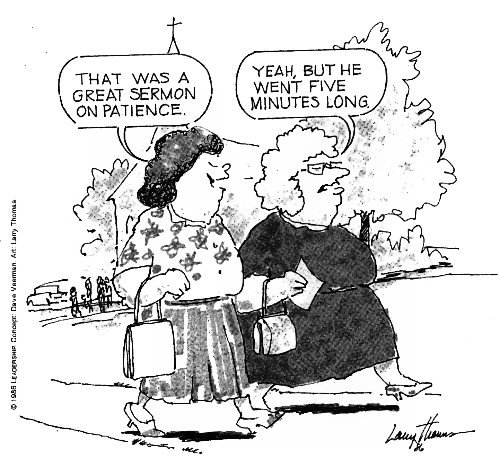
Dave Veerman and Larry Thomas
The Best Cartoons from Leadership Journal, Vol. 1

Hearing and Practicing Patience
Dave Veerman and Larry Thomas
The Best Cartoons from Leadership Journal, Vol. 1
Tuesday, October 3, 2006
Poliomyelitis- a disease that just will not go away
Poliomyelitis, an old disease strikes back
Dr Alex Tang
There had been high hopes that poliomyelitis or polio can be eradicated by the year 2000. The WHO has organized massive immunization programs and almost all countries use the WHO immunization schedule which includes vaccination against diphtheria, tetanus, and poliomyelitis. The Rotary Foundation has spent billions of dollars to ensure that children in the most remote areas receive the vaccine. With the combined might of the WHO and the NGO, the Rotary Foundation, there had been high hopes that poliomyelitis will go the way of smallpox.
Poliomyelitis cause paralysis of major muscles. In the old days, children with poliomyelitis have difficulty breathing as their respiratory muscles were paralyzed. They were placed in “iron lungs” which help them to breathe. The “iron lungs’ worked by alternately creating and releasing a vacuum.
In March 2005, a 20 months old boy was founded to be infected with a wild strain of polio virus in Girijaya village in the Sukabumi district of West Java. In spite of massive immunization of the Indonesian government, the outbreak resulted in 305 cases in 2005-2006 and claimed 6 lives. 47 districts and 10 provinces were affected. This virus was traced to its origin in Nigeria. It reached Indonesia via Yemen, Saudi Arabia and West Java. From there it spread to central Java, the Madera Islands and to Sumatra.
What went wrong? It was found that the polio vaccine coverage in Indonesia has dropped from more than 90% to 77.6% in 2005. Again, this is a reminder that we are fighting a holding battle against outbreaks of diseases like polio. We cannot afford to relax our vigilance.
There are two types of vaccines for polio. The Salk vaccine which is made up of the killed polio virus and the Sabin vaccine which is made from the weakened polio virus. Salk and Sabin are the names of two medical pioneers who did a lot of work on poliomyelitis. The Salk vaccine is given by injection into the muscles while the Sabin vaccine is given orally.
WHO made a decision to use the oral Sabin polio vaccine exclusively. The Malaysian Ministry of Health follows this decision religiously. However, there are two vaccine related problems with the oral polio vaccine which is not found in the injection polio vaccine.
First, it was found that the oral polio vaccine can cause polio! It was estimated that there are 400-800 cases of vaccine polio worldwide yearly. Vaccine polio can cause outbreaks; Hispaniola Islands in 2000, Indonesia in 2005 while the longest lasting was for 10 years in Egypt from 1983-1993.
Second, oral polio vaccine can cause paralysis. The muscles of affected children become flaccid. This condition is named vaccine associated paralytic polio (VAPP). It occurs in one per million does of oral polio vaccines.
One of the arguments against the use of injection polio vaccine was the “absence of herd immunity”. As the recent outbreaks in Indonesia shows, that argument is not longer valid since the polio outbreak occurs in spite of the community having “herd immunity’. Europe, Canada, South Korea, Australia, New Zealand, Japan and USA has all changed to injection polio vaccine in the last decade and there have been no significant outbreaks of polio reported.
The WHO recommends that the oral polio vaccine be discontinued as soon as polio was eradicated in 2000. It is now already 6 years past that dateline and we still have not eradicated the disease polio. Maybe it is time our Health Ministry should reconsider the WHO recommendation and make the decision to switch to injection polio vaccine independently. Most of the developed countries have already switched to injection polio vaccine.
The battle against polio has not been won. The polio vaccine has offered us an effective instrument to hold the disease at bay. Unfortunately the vaccine has created two new vaccine related diseases. The trade off is good but we could do better.
Dr Alex Tang
There had been high hopes that poliomyelitis or polio can be eradicated by the year 2000. The WHO has organized massive immunization programs and almost all countries use the WHO immunization schedule which includes vaccination against diphtheria, tetanus, and poliomyelitis. The Rotary Foundation has spent billions of dollars to ensure that children in the most remote areas receive the vaccine. With the combined might of the WHO and the NGO, the Rotary Foundation, there had been high hopes that poliomyelitis will go the way of smallpox.
Poliomyelitis cause paralysis of major muscles. In the old days, children with poliomyelitis have difficulty breathing as their respiratory muscles were paralyzed. They were placed in “iron lungs” which help them to breathe. The “iron lungs’ worked by alternately creating and releasing a vacuum.
In March 2005, a 20 months old boy was founded to be infected with a wild strain of polio virus in Girijaya village in the Sukabumi district of West Java. In spite of massive immunization of the Indonesian government, the outbreak resulted in 305 cases in 2005-2006 and claimed 6 lives. 47 districts and 10 provinces were affected. This virus was traced to its origin in Nigeria. It reached Indonesia via Yemen, Saudi Arabia and West Java. From there it spread to central Java, the Madera Islands and to Sumatra.
What went wrong? It was found that the polio vaccine coverage in Indonesia has dropped from more than 90% to 77.6% in 2005. Again, this is a reminder that we are fighting a holding battle against outbreaks of diseases like polio. We cannot afford to relax our vigilance.
There are two types of vaccines for polio. The Salk vaccine which is made up of the killed polio virus and the Sabin vaccine which is made from the weakened polio virus. Salk and Sabin are the names of two medical pioneers who did a lot of work on poliomyelitis. The Salk vaccine is given by injection into the muscles while the Sabin vaccine is given orally.
WHO made a decision to use the oral Sabin polio vaccine exclusively. The Malaysian Ministry of Health follows this decision religiously. However, there are two vaccine related problems with the oral polio vaccine which is not found in the injection polio vaccine.
First, it was found that the oral polio vaccine can cause polio! It was estimated that there are 400-800 cases of vaccine polio worldwide yearly. Vaccine polio can cause outbreaks; Hispaniola Islands in 2000, Indonesia in 2005 while the longest lasting was for 10 years in Egypt from 1983-1993.
Second, oral polio vaccine can cause paralysis. The muscles of affected children become flaccid. This condition is named vaccine associated paralytic polio (VAPP). It occurs in one per million does of oral polio vaccines.
One of the arguments against the use of injection polio vaccine was the “absence of herd immunity”. As the recent outbreaks in Indonesia shows, that argument is not longer valid since the polio outbreak occurs in spite of the community having “herd immunity’. Europe, Canada, South Korea, Australia, New Zealand, Japan and USA has all changed to injection polio vaccine in the last decade and there have been no significant outbreaks of polio reported.
The WHO recommends that the oral polio vaccine be discontinued as soon as polio was eradicated in 2000. It is now already 6 years past that dateline and we still have not eradicated the disease polio. Maybe it is time our Health Ministry should reconsider the WHO recommendation and make the decision to switch to injection polio vaccine independently. Most of the developed countries have already switched to injection polio vaccine.
The battle against polio has not been won. The polio vaccine has offered us an effective instrument to hold the disease at bay. Unfortunately the vaccine has created two new vaccine related diseases. The trade off is good but we could do better.
Poliomyelitis- a disease that just will not go away
Poliomyelitis, an old disease strikes back
Dr Alex Tang
There had been high hopes that poliomyelitis or polio can be eradicated by the year 2000. The WHO has organized massive immunization programs and almost all countries use the WHO immunization schedule which includes vaccination against diphtheria, tetanus, and poliomyelitis. The Rotary Foundation has spent billions of dollars to ensure that children in the most remote areas receive the vaccine. With the combined might of the WHO and the NGO, the Rotary Foundation, there had been high hopes that poliomyelitis will go the way of smallpox.
Poliomyelitis cause paralysis of major muscles. In the old days, children with poliomyelitis have difficulty breathing as their respiratory muscles were paralyzed. They were placed in “iron lungs” which help them to breathe. The “iron lungs’ worked by alternately creating and releasing a vacuum.
In March 2005, a 20 months old boy was founded to be infected with a wild strain of polio virus in Girijaya village in the Sukabumi district of West Java. In spite of massive immunization of the Indonesian government, the outbreak resulted in 305 cases in 2005-2006 and claimed 6 lives. 47 districts and 10 provinces were affected. This virus was traced to its origin in Nigeria. It reached Indonesia via Yemen, Saudi Arabia and West Java. From there it spread to central Java, the Madera Islands and to Sumatra.
What went wrong? It was found that the polio vaccine coverage in Indonesia has dropped from more than 90% to 77.6% in 2005. Again, this is a reminder that we are fighting a holding battle against outbreaks of diseases like polio. We cannot afford to relax our vigilance.
There are two types of vaccines for polio. The Salk vaccine which is made up of the killed polio virus and the Sabin vaccine which is made from the weakened polio virus. Salk and Sabin are the names of two medical pioneers who did a lot of work on poliomyelitis. The Salk vaccine is given by injection into the muscles while the Sabin vaccine is given orally.
WHO made a decision to use the oral Sabin polio vaccine exclusively. The Malaysian Ministry of Health follows this decision religiously. However, there are two vaccine related problems with the oral polio vaccine which is not found in the injection polio vaccine.
First, it was found that the oral polio vaccine can cause polio! It was estimated that there are 400-800 cases of vaccine polio worldwide yearly. Vaccine polio can cause outbreaks; Hispaniola Islands in 2000, Indonesia in 2005 while the longest lasting was for 10 years in Egypt from 1983-1993.
Second, oral polio vaccine can cause paralysis. The muscles of affected children become flaccid. This condition is named vaccine associated paralytic polio (VAPP). It occurs in one per million does of oral polio vaccines.
One of the arguments against the use of injection polio vaccine was the “absence of herd immunity”. As the recent outbreaks in Indonesia shows, that argument is not longer valid since the polio outbreak occurs in spite of the community having “herd immunity’. Europe, Canada, South Korea, Australia, New Zealand, Japan and USA has all changed to injection polio vaccine in the last decade and there have been no significant outbreaks of polio reported.
The WHO recommends that the oral polio vaccine be discontinued as soon as polio was eradicated in 2000. It is now already 6 years past that dateline and we still have not eradicated the disease polio. Maybe it is time our Health Ministry should reconsider the WHO recommendation and make the decision to switch to injection polio vaccine independently. Most of the developed countries have already switched to injection polio vaccine.
The battle against polio has not been won. The polio vaccine has offered us an effective instrument to hold the disease at bay. Unfortunately the vaccine has created two new vaccine related diseases. The trade off is good but we could do better.
Dr Alex Tang
There had been high hopes that poliomyelitis or polio can be eradicated by the year 2000. The WHO has organized massive immunization programs and almost all countries use the WHO immunization schedule which includes vaccination against diphtheria, tetanus, and poliomyelitis. The Rotary Foundation has spent billions of dollars to ensure that children in the most remote areas receive the vaccine. With the combined might of the WHO and the NGO, the Rotary Foundation, there had been high hopes that poliomyelitis will go the way of smallpox.
Poliomyelitis cause paralysis of major muscles. In the old days, children with poliomyelitis have difficulty breathing as their respiratory muscles were paralyzed. They were placed in “iron lungs” which help them to breathe. The “iron lungs’ worked by alternately creating and releasing a vacuum.
In March 2005, a 20 months old boy was founded to be infected with a wild strain of polio virus in Girijaya village in the Sukabumi district of West Java. In spite of massive immunization of the Indonesian government, the outbreak resulted in 305 cases in 2005-2006 and claimed 6 lives. 47 districts and 10 provinces were affected. This virus was traced to its origin in Nigeria. It reached Indonesia via Yemen, Saudi Arabia and West Java. From there it spread to central Java, the Madera Islands and to Sumatra.
What went wrong? It was found that the polio vaccine coverage in Indonesia has dropped from more than 90% to 77.6% in 2005. Again, this is a reminder that we are fighting a holding battle against outbreaks of diseases like polio. We cannot afford to relax our vigilance.
There are two types of vaccines for polio. The Salk vaccine which is made up of the killed polio virus and the Sabin vaccine which is made from the weakened polio virus. Salk and Sabin are the names of two medical pioneers who did a lot of work on poliomyelitis. The Salk vaccine is given by injection into the muscles while the Sabin vaccine is given orally.
WHO made a decision to use the oral Sabin polio vaccine exclusively. The Malaysian Ministry of Health follows this decision religiously. However, there are two vaccine related problems with the oral polio vaccine which is not found in the injection polio vaccine.
First, it was found that the oral polio vaccine can cause polio! It was estimated that there are 400-800 cases of vaccine polio worldwide yearly. Vaccine polio can cause outbreaks; Hispaniola Islands in 2000, Indonesia in 2005 while the longest lasting was for 10 years in Egypt from 1983-1993.
Second, oral polio vaccine can cause paralysis. The muscles of affected children become flaccid. This condition is named vaccine associated paralytic polio (VAPP). It occurs in one per million does of oral polio vaccines.
One of the arguments against the use of injection polio vaccine was the “absence of herd immunity”. As the recent outbreaks in Indonesia shows, that argument is not longer valid since the polio outbreak occurs in spite of the community having “herd immunity’. Europe, Canada, South Korea, Australia, New Zealand, Japan and USA has all changed to injection polio vaccine in the last decade and there have been no significant outbreaks of polio reported.
The WHO recommends that the oral polio vaccine be discontinued as soon as polio was eradicated in 2000. It is now already 6 years past that dateline and we still have not eradicated the disease polio. Maybe it is time our Health Ministry should reconsider the WHO recommendation and make the decision to switch to injection polio vaccine independently. Most of the developed countries have already switched to injection polio vaccine.
The battle against polio has not been won. The polio vaccine has offered us an effective instrument to hold the disease at bay. Unfortunately the vaccine has created two new vaccine related diseases. The trade off is good but we could do better.
Monday, October 2, 2006
The House of M
 The House of M was Marvel’s 2005-2006 major storyline that links many Marvel titles. Charles Xavier (Professor X) and Erik (Magneto) used to be the two most powerful mutants on earth. Somehow along the way, other mutants like Jean Grey who became the Phoenix, became dangerously powerful. Wanda Maximoff used to be a minor player in the X-men saga. Her hex power was relatively weak. Wanda is the daughter of Magneto. Again somehow along the years (through deconstruction and revisionist story telling), her power became so powerful that she can alter reality itself!
 Wanda had a nervous breakdown while fighting with the New Avengers and unleashed terrible damage to her team mates. Hawkeye was killed while several others were injured. Magneto came to her rescue and brought her to Genosha, the devastated mutant island-nation. Here with the help of Charles Xavier, they tried to help her. Unfortunately, her mental condition was so unstable that Charles Xavier with Doctor Strange was unable to help her. She was considered so dangerous that Charles called a meeting of the New Avengers and the Astonishing X-Men to propose a drastic solution. In order to keep the world safe, they will have to kill her. This is reminiscent of the DC storyline of mind wiping one of their own but more drastic. A vote was taken and it was decided that Wanda has to be eliminated. And these are the good guys!
When both teams reach Genosha, Wanda was hidden by her brother Pietro (Quicksilver) who was trying to save her life. In the meantime, everyone blame Magneto for her disappearance. At a crucial moment, everything turned white and reality as we can to know it changed.
In the new reality, Wanda gave the heroes what they had always wanted in life. Magneto is Erik Magnus, the Monarch of the House of M, ruler of most of the world. Mutants have taken over control of everything. Normal human beings or sapiens are now the second class citizens. They are discriminated against, exploited and oppressed. This reminds me of the Planet of the Apes saga. Normal humans are expected to die out in a few generations.
What about our heroes? Well, everyone except James Howlett (Wolverine) did not have memories of their previous lives. On the other hand, James Howlett/Logan/Wolverine remembers everything!
This gives an interesting opportunity for the writers to explore a few “what if” situations. Like Captain Kirk and Captain Picard in the Nexus in the movie “Generations”, they have an opportunity to live the life they always wanted. For James T. Kirk, it is to live with the woman he loves and for Jean-Luc, it is to have a wife and family. Peter Parker is an actor, professional wrestler and CEO of Spider-Man, Inc. He is a celebrity, married to Gwen Stacy and has a child. Uncle Ben is alive with Aunt May. Now, why would he want to be back the way it was?
Other heroes are not so lucky. Tony Stark (Iron-Man) is still under the control of his father, Howard and has a dysfunctional childhood. Reed Richards is dead and there was no Fantastic Four. Dr. Doom is the ruler of Latveria. He is married to his childhood sweetheart and his mother is still alive. He formed a team called the Fearsome Four who does the House of M’s dirty work. Bruce Banner goes green and links up with the Aborigines in Australia, Captain Britain is called back to realign realities and Sebastian Shaw is head of S.H.I.E.L.D!
Nick Fury, being a human is given a job of a drill sergeant. Captain America, also human was given early retirement. You get the picture? I will not give away the plot by revealing how our reality was restored.
This is an entertaining storyline which involves Excalibur, the Astonishing X-Men, The New Avengers, Fantastic Four, Spiderman, Incredible Hulk, Iron Man, Black Panther, Uncanny X-Men and New X-Men Academy. Lots of people are involved. Some of the stories makes sense and try to explore what life could have been for these superheroes if what had happened to them did not happen. Some of the stories are nonsense with lots of wham, bang and girls in skimpy clothing. I could not help but wonder what the Batman will be like in this reality. It is difficult to read the story knowing that at the end of it all, the present reality will be restored. Magneto though he is the absolute Monarch of the House of M did come out impressive. Most of the time, he just seems confused or a bad caricature of a bad villain.
The normal human are treated badly by the mutants. They have developed a human resistant movement and there are also terrorist groups. Again the treatment of this aspect of the dominant species becoming the underdog was not examined deeply. I would give this series a two and a half star. It is worth a read if you run out of manga on a Saturday afternoon.
The House of M
The House of M was Marvel’s 2005-2006 major storyline that links many Marvel titles. Charles Xavier (Professor X) and Erik (Magneto) used to be the two most powerful mutants on earth. Somehow along the way, other mutants like Jean Grey who became the Phoenix, became dangerously powerful. Wanda Maximoff used to be a minor player in the X-men saga. Her hex power was relatively weak. Wanda is the daughter of Magneto. Again somehow along the years (through deconstruction and revisionist story telling), her power became so powerful that she can alter reality itself! Wanda had a nervous breakdown while fighting with the New Avengers and unleashed terrible damage to her team mates. Hawkeye was killed while several others were injured. Magneto came to her rescue and brought her to Genosha, the devastated mutant island-nation. Here with the help of Charles Xavier, they tried to help her. Unfortunately, her mental condition was so unstable that Charles Xavier with Doctor Strange was unable to help her. She was considered so dangerous that Charles called a meeting of the New Avengers and the Astonishing X-Men to propose a drastic solution. In order to keep the world safe, they will have to kill her. This is reminiscent of the DC storyline of mind wiping one of their own but more drastic. A vote was taken and it was decided that Wanda has to be eliminated. And these are the good guys!When both teams reach Genosha, Wanda was hidden by her brother Pietro (Quicksilver) who was trying to save her life. In the meantime, everyone blame Magneto for her disappearance. At a crucial moment, everything turned white and reality as we can to know it changed.
In the new reality, Wanda gave the heroes what they had always wanted in life. Magneto is Erik Magnus, the Monarch of the House of M, ruler of most of the world. Mutants have taken over control of everything. Normal human beings or sapiens are now the second class citizens. They are discriminated against, exploited and oppressed. This reminds me of the Planet of the Apes saga. Normal humans are expected to die out in a few generations.
What about our heroes? Well, everyone except James Howlett (Wolverine) did not have memories of their previous lives. On the other hand, James Howlett/Logan/Wolverine remembers everything!
This gives an interesting opportunity for the writers to explore a few “what if” situations. Like Captain Kirk and Captain Picard in the Nexus in the movie “Generations”, they have an opportunity to live the life they always wanted. For James T. Kirk, it is to live with the woman he loves and for Jean-Luc, it is to have a wife and family. Peter Parker is an actor, professional wrestler and CEO of Spider-Man, Inc. He is a celebrity, married to Gwen Stacy and has a child. Uncle Ben is alive with Aunt May. Now, why would he want to be back the way it was?
Other heroes are not so lucky. Tony Stark (Iron-Man) is still under the control of his father, Howard and has a dysfunctional childhood. Reed Richards is dead and there was no Fantastic Four. Dr. Doom is the ruler of Latveria. He is married to his childhood sweetheart and his mother is still alive. He formed a team called the Fearsome Four who does the House of M’s dirty work. Bruce Banner goes green and links up with the Aborigines in Australia, Captain Britain is called back to realign realities and Sebastian Shaw is head of S.H.I.E.L.D!
Nick Fury, being a human is given a job of a drill sergeant. Captain America, also human was given early retirement. You get the picture? I will not give away the plot by revealing how our reality was restored.
This is an entertaining storyline which involves Excalibur, the Astonishing X-Men, The New Avengers, Fantastic Four, Spiderman, Incredible Hulk, Iron Man, Black Panther, Uncanny X-Men and New X-Men Academy. Lots of people are involved. Some of the stories makes sense and try to explore what life could have been for these superheroes if what had happened to them did not happen. Some of the stories are nonsense with lots of wham, bang and girls in skimpy clothing. I could not help but wonder what the Batman will be like in this reality. It is difficult to read the story knowing that at the end of it all, the present reality will be restored. Magneto though he is the absolute Monarch of the House of M did come out impressive. Most of the time, he just seems confused or a bad caricature of a bad villain.
The normal human are treated badly by the mutants. They have developed a human resistant movement and there are also terrorist groups. Again the treatment of this aspect of the dominant species becoming the underdog was not examined deeply. I would give this series a two and a half star. It is worth a read if you run out of manga on a Saturday afternoon.
The Boys' Brigade of Malaysia
William Alexander Smith was born in Thurso, Scotland in 1854. He moved to Glasgow in his teens and became involved in church activities. William was also a lieutenant in the 1st Lanarkshire Rifle Volunteers in 1883 while he was teaching in the North Woodside Mission Sunday School. While working with the children in church, he discovered the need for wholesome activities for children outside school hours. William Smith shared his ideas with his two friends, which later invited boys from North Woodside Mission Sabbath School and formed the first company of The Boys' Brigade, 1st Glasgow Company on 4th of October 1883. It is the world's first uniform organization, even before the Scouts.
 William was the first Brigade Secretary in 1887 where he worked towards spreading the Brigade across the world. In 1909, King Edward VII knighted William Smith for his contribution towards youth development. Five years later, Sir William Alexander Smith passed away. Throughout his lifetime, Sir William A. Smith poured out all that he has into BB and he is best remembered as the man who spells Boy with a capital 'B'.
The original object of the Boys' Brigade is the advancement of Christ's Kingdom among Boys and the promotion of habits of obedience, reverence, discipline, self-respect and all that tend towards a true Christian manliness. Christian “manliness” was developed by the use of a semi-military discipline and order, gymnastics, summer camps and religious services and classes. Christian manliness was changed to Christian character when girls were admitted to the BB.
However, the BB did not appear in the Asian scene until 1915 when the first Company was founded in the Chinese city of Swatow by the Rev Guthrie Gamble (the famous Swatow BB was to become a legend in later years in China) The BB came to South East Asia in 1930 with the founding of the 1st Singapore Company by Mr James Fraser.
The Boys’ Brigade did not come to Malaya until the after the second World War. A British soldier by the name of Robert Davis (former Captain of 6th Birkenhead Company at the Tranmere Freehold Methodist Church and later Tranmere United Reformed Church) gave the idea of The Boys’ Brigade to one of Penang’s great educationist, the late Mr Geh Hun Kheng, who accepted the challenge becoming the first BB Captain in Malaya. Mr Geh realised that he had to do his "small share" to win the Boys over from the various subversive groups that were so rife after the Pacific War. The first meeting of 20 Boys was held in the Methodist Church in Madras Lane on a Sunday in September 1946. Penang thus became the springboard from which Companies were started first in Kuala Lumpur and then in other parts of the country. When Malaysia achieved independence on 31 August 1957, The Boys’ Brigade was given the honour of being invited to take part in the Merdeka Parade (Independence Day Parade).
After Merdeka (Independence), The Boys’ Brigade began to spread rapidly as a result of the formation of the Malayan Council of The Boys’ Brigade under the initiative of Mr Khoo Oon Soo. More and more Companies were founded in every major town in Malaya. Even small rural towns began to have BB Companies functioning efficiently. By this time firm and friendly contact had been made with the BB in Singapore which helped in the supply and sale of equipment and with the founding of the first Company in Borneo in 1959, the 1st Kuching Company. In 1962, the BB in Malaya became a member of the Pacific Regional Fellowship (subsequently joined the East Asia Regional Fellowship when it was formed later) and the first Pacific camp was held with the co-operation of the Singapore Battalion in Port Dickson in December 1963.
On 5 December 1964, the former Federation of Malaya Council of The Boys’ Brigade, the Singapore Battalion and the 1st Kuching Company merged into The Boys’ Brigade in Malaysia. With the political separation of Singapore from Malaysia, The Boys’ Brigade in Singapore ceased to be a component District of The Boys’ Brigade in Malaysia as on 19 August 1965. With Malaysia a reality the National Council began to establish Companies in Sabah and Sarawak, maintaining friendly ties with the BB in Singapore.
The development of The Boys’ Brigade in Malaysia took a revolutionary turn when it invited girls to be members. It was first introduced in 1989 and debated for a few years before experimental measures were approved in 1992. The move received favourable response and strong support from churches and individuals. Starting of the girls’ wing was to cater for the girls in a locality where a Girls’ Brigade Company did not exist. Today, more than 20 companies in the BBM have girls on their membership roll, and many girls have been appointed NCOs, and they have proven to be capable in adapting well to the activities of the BB.
Since 1992, The Boys’ Brigade in Malaysia has also begun to play significant role in the extension of BB work in the East Asia Regional Fellowship, including conducting training and support BB works in Indonesia, Thailand and the Philippines.
Today, there are over 70 Companies spread throughout the length and breadth of Malaysia. Ever since the setting up of a BBHQ in 1989, a permanent building has been purchased, and currently staffed by a team of 5 able full-time personnel.
The Boys’ Brigade in Malaysia has come a long way since 1946. Many things have since changed, many had come and gone with many new developments taken place. Throughout all these years, the BBM has been able to hold on to its object and continue in serving the youth of Malaysia. As the nation is fast moving towards greater heights in development, it is believed that the BB shall be called on to play an even greater role in the development and training of the Malaysian youths.
The BB is recognised by Kementerian Belia dan Sukan Malaysia as a youth body and by Kementerian Pendidikan Malaysia as a school's extra co-curricular activity. This means BB is the only formally recognized uniformed Christian youth organization recognized by the government and allowed to be part of the schools extra co-curricular activities. BB is also an affliated member of Majlis Belia Malaysia and Council of Churches of Malaysia
Object
The Advancement of Christ's Kingdom among members and the promotion of habits of Obedience, Reverence, Discipline, Self-Respect and all that tends towards a true Christian Character.
Motto
SURE & STEDFAST (taken from Hebrews 6:19). The original Old English (King James Version) spelling of "Stedfast" has been retained.
Emblem
 The emblem is original an anchor. Like the motto it stems from the verse "We have this hope as an anchor for the soul, firm and secure" (Hebrews 6:19)
Please support the Boys' Brigade by praying for them, getting your children to join them and get involved with them.
 William was the first Brigade Secretary in 1887 where he worked towards spreading the Brigade across the world. In 1909, King Edward VII knighted William Smith for his contribution towards youth development. Five years later, Sir William Alexander Smith passed away. Throughout his lifetime, Sir William A. Smith poured out all that he has into BB and he is best remembered as the man who spells Boy with a capital 'B'.
The original object of the Boys' Brigade is the advancement of Christ's Kingdom among Boys and the promotion of habits of obedience, reverence, discipline, self-respect and all that tend towards a true Christian manliness. Christian “manliness” was developed by the use of a semi-military discipline and order, gymnastics, summer camps and religious services and classes. Christian manliness was changed to Christian character when girls were admitted to the BB.
However, the BB did not appear in the Asian scene until 1915 when the first Company was founded in the Chinese city of Swatow by the Rev Guthrie Gamble (the famous Swatow BB was to become a legend in later years in China) The BB came to South East Asia in 1930 with the founding of the 1st Singapore Company by Mr James Fraser.
The Boys’ Brigade did not come to Malaya until the after the second World War. A British soldier by the name of Robert Davis (former Captain of 6th Birkenhead Company at the Tranmere Freehold Methodist Church and later Tranmere United Reformed Church) gave the idea of The Boys’ Brigade to one of Penang’s great educationist, the late Mr Geh Hun Kheng, who accepted the challenge becoming the first BB Captain in Malaya. Mr Geh realised that he had to do his "small share" to win the Boys over from the various subversive groups that were so rife after the Pacific War. The first meeting of 20 Boys was held in the Methodist Church in Madras Lane on a Sunday in September 1946. Penang thus became the springboard from which Companies were started first in Kuala Lumpur and then in other parts of the country. When Malaysia achieved independence on 31 August 1957, The Boys’ Brigade was given the honour of being invited to take part in the Merdeka Parade (Independence Day Parade).
After Merdeka (Independence), The Boys’ Brigade began to spread rapidly as a result of the formation of the Malayan Council of The Boys’ Brigade under the initiative of Mr Khoo Oon Soo. More and more Companies were founded in every major town in Malaya. Even small rural towns began to have BB Companies functioning efficiently. By this time firm and friendly contact had been made with the BB in Singapore which helped in the supply and sale of equipment and with the founding of the first Company in Borneo in 1959, the 1st Kuching Company. In 1962, the BB in Malaya became a member of the Pacific Regional Fellowship (subsequently joined the East Asia Regional Fellowship when it was formed later) and the first Pacific camp was held with the co-operation of the Singapore Battalion in Port Dickson in December 1963.
On 5 December 1964, the former Federation of Malaya Council of The Boys’ Brigade, the Singapore Battalion and the 1st Kuching Company merged into The Boys’ Brigade in Malaysia. With the political separation of Singapore from Malaysia, The Boys’ Brigade in Singapore ceased to be a component District of The Boys’ Brigade in Malaysia as on 19 August 1965. With Malaysia a reality the National Council began to establish Companies in Sabah and Sarawak, maintaining friendly ties with the BB in Singapore.
The development of The Boys’ Brigade in Malaysia took a revolutionary turn when it invited girls to be members. It was first introduced in 1989 and debated for a few years before experimental measures were approved in 1992. The move received favourable response and strong support from churches and individuals. Starting of the girls’ wing was to cater for the girls in a locality where a Girls’ Brigade Company did not exist. Today, more than 20 companies in the BBM have girls on their membership roll, and many girls have been appointed NCOs, and they have proven to be capable in adapting well to the activities of the BB.
Since 1992, The Boys’ Brigade in Malaysia has also begun to play significant role in the extension of BB work in the East Asia Regional Fellowship, including conducting training and support BB works in Indonesia, Thailand and the Philippines.
Today, there are over 70 Companies spread throughout the length and breadth of Malaysia. Ever since the setting up of a BBHQ in 1989, a permanent building has been purchased, and currently staffed by a team of 5 able full-time personnel.
The Boys’ Brigade in Malaysia has come a long way since 1946. Many things have since changed, many had come and gone with many new developments taken place. Throughout all these years, the BBM has been able to hold on to its object and continue in serving the youth of Malaysia. As the nation is fast moving towards greater heights in development, it is believed that the BB shall be called on to play an even greater role in the development and training of the Malaysian youths.
The BB is recognised by Kementerian Belia dan Sukan Malaysia as a youth body and by Kementerian Pendidikan Malaysia as a school's extra co-curricular activity. This means BB is the only formally recognized uniformed Christian youth organization recognized by the government and allowed to be part of the schools extra co-curricular activities. BB is also an affliated member of Majlis Belia Malaysia and Council of Churches of Malaysia
Object
The Advancement of Christ's Kingdom among members and the promotion of habits of Obedience, Reverence, Discipline, Self-Respect and all that tends towards a true Christian Character.
Motto
SURE & STEDFAST (taken from Hebrews 6:19). The original Old English (King James Version) spelling of "Stedfast" has been retained.
Emblem
 The emblem is original an anchor. Like the motto it stems from the verse "We have this hope as an anchor for the soul, firm and secure" (Hebrews 6:19)
Please support the Boys' Brigade by praying for them, getting your children to join them and get involved with them.
The Boys' Brigade of Malaysia
William Alexander Smith was born in Thurso, Scotland in 1854. He moved to Glasgow in his teens and became involved in church activities. William was also a lieutenant in the 1st Lanarkshire Rifle Volunteers in 1883 while he was teaching in the North Woodside Mission Sunday School. While working with the children in church, he discovered the need for wholesome activities for children outside school hours. William Smith shared his ideas with his two friends, which later invited boys from North Woodside Mission Sabbath School and formed the first company of The Boys' Brigade, 1st Glasgow Company on 4th of October 1883. It is the world's first uniform organization, even before the Scouts.
William was the first Brigade Secretary in 1887 where he worked towards spreading the Brigade across the world. In 1909, King Edward VII knighted William Smith for his contribution towards youth development. Five years later, Sir William Alexander Smith passed away. Throughout his lifetime, Sir William A. Smith poured out all that he has into BB and he is best remembered as the man who spells Boy with a capital 'B'.
The original object of the Boys' Brigade is the advancement of Christ's Kingdom among Boys and the promotion of habits of obedience, reverence, discipline, self-respect and all that tend towards a true Christian manliness. Christian “manliness” was developed by the use of a semi-military discipline and order, gymnastics, summer camps and religious services and classes. Christian manliness was changed to Christian character when girls were admitted to the BB.
However, the BB did not appear in the Asian scene until 1915 when the first Company was founded in the Chinese city of Swatow by the Rev Guthrie Gamble (the famous Swatow BB was to become a legend in later years in China) The BB came to South East Asia in 1930 with the founding of the 1st Singapore Company by Mr James Fraser.
The Boys’ Brigade did not come to Malaya until the after the second World War. A British soldier by the name of Robert Davis (former Captain of 6th Birkenhead Company at the Tranmere Freehold Methodist Church and later Tranmere United Reformed Church) gave the idea of The Boys’ Brigade to one of Penang’s great educationist, the late Mr Geh Hun Kheng, who accepted the challenge becoming the first BB Captain in Malaya. Mr Geh realised that he had to do his "small share" to win the Boys over from the various subversive groups that were so rife after the Pacific War. The first meeting of 20 Boys was held in the Methodist Church in Madras Lane on a Sunday in September 1946. Penang thus became the springboard from which Companies were started first in Kuala Lumpur and then in other parts of the country. When Malaysia achieved independence on 31 August 1957, The Boys’ Brigade was given the honour of being invited to take part in the Merdeka Parade (Independence Day Parade).
After Merdeka (Independence), The Boys’ Brigade began to spread rapidly as a result of the formation of the Malayan Council of The Boys’ Brigade under the initiative of Mr Khoo Oon Soo. More and more Companies were founded in every major town in Malaya. Even small rural towns began to have BB Companies functioning efficiently. By this time firm and friendly contact had been made with the BB in Singapore which helped in the supply and sale of equipment and with the founding of the first Company in Borneo in 1959, the 1st Kuching Company. In 1962, the BB in Malaya became a member of the Pacific Regional Fellowship (subsequently joined the East Asia Regional Fellowship when it was formed later) and the first Pacific camp was held with the co-operation of the Singapore Battalion in Port Dickson in December 1963.
On 5 December 1964, the former Federation of Malaya Council of The Boys’ Brigade, the Singapore Battalion and the 1st Kuching Company merged into The Boys’ Brigade in Malaysia. With the political separation of Singapore from Malaysia, The Boys’ Brigade in Singapore ceased to be a component District of The Boys’ Brigade in Malaysia as on 19 August 1965. With Malaysia a reality the National Council began to establish Companies in Sabah and Sarawak, maintaining friendly ties with the BB in Singapore.
The development of The Boys’ Brigade in Malaysia took a revolutionary turn when it invited girls to be members. It was first introduced in 1989 and debated for a few years before experimental measures were approved in 1992. The move received favourable response and strong support from churches and individuals. Starting of the girls’ wing was to cater for the girls in a locality where a Girls’ Brigade Company did not exist. Today, more than 20 companies in the BBM have girls on their membership roll, and many girls have been appointed NCOs, and they have proven to be capable in adapting well to the activities of the BB.
Since 1992, The Boys’ Brigade in Malaysia has also begun to play significant role in the extension of BB work in the East Asia Regional Fellowship, including conducting training and support BB works in Indonesia, Thailand and the Philippines.
Today, there are over 70 Companies spread throughout the length and breadth of Malaysia. Ever since the setting up of a BBHQ in 1989, a permanent building has been purchased, and currently staffed by a team of 5 able full-time personnel.
The Boys’ Brigade in Malaysia has come a long way since 1946. Many things have since changed, many had come and gone with many new developments taken place. Throughout all these years, the BBM has been able to hold on to its object and continue in serving the youth of Malaysia. As the nation is fast moving towards greater heights in development, it is believed that the BB shall be called on to play an even greater role in the development and training of the Malaysian youths.
The BB is recognised by Kementerian Belia dan Sukan Malaysia as a youth body and by Kementerian Pendidikan Malaysia as a school's extra co-curricular activity. This means BB is the only formally recognized uniformed Christian youth organization recognized by the government and allowed to be part of the schools extra co-curricular activities. BB is also an affliated member of Majlis Belia Malaysia and Council of Churches of Malaysia
Object
The Advancement of Christ's Kingdom among members and the promotion of habits of Obedience, Reverence, Discipline, Self-Respect and all that tends towards a true Christian Character.
Motto
SURE & STEDFAST (taken from Hebrews 6:19). The original Old English (King James Version) spelling of "Stedfast" has been retained.
Emblem
The emblem is original an anchor. Like the motto it stems from the verse "We have this hope as an anchor for the soul, firm and secure" (Hebrews 6:19)
Please support the Boys' Brigade by praying for them, getting your children to join them and get involved with them.
William was the first Brigade Secretary in 1887 where he worked towards spreading the Brigade across the world. In 1909, King Edward VII knighted William Smith for his contribution towards youth development. Five years later, Sir William Alexander Smith passed away. Throughout his lifetime, Sir William A. Smith poured out all that he has into BB and he is best remembered as the man who spells Boy with a capital 'B'.The original object of the Boys' Brigade is the advancement of Christ's Kingdom among Boys and the promotion of habits of obedience, reverence, discipline, self-respect and all that tend towards a true Christian manliness. Christian “manliness” was developed by the use of a semi-military discipline and order, gymnastics, summer camps and religious services and classes. Christian manliness was changed to Christian character when girls were admitted to the BB.
However, the BB did not appear in the Asian scene until 1915 when the first Company was founded in the Chinese city of Swatow by the Rev Guthrie Gamble (the famous Swatow BB was to become a legend in later years in China) The BB came to South East Asia in 1930 with the founding of the 1st Singapore Company by Mr James Fraser.
The Boys’ Brigade did not come to Malaya until the after the second World War. A British soldier by the name of Robert Davis (former Captain of 6th Birkenhead Company at the Tranmere Freehold Methodist Church and later Tranmere United Reformed Church) gave the idea of The Boys’ Brigade to one of Penang’s great educationist, the late Mr Geh Hun Kheng, who accepted the challenge becoming the first BB Captain in Malaya. Mr Geh realised that he had to do his "small share" to win the Boys over from the various subversive groups that were so rife after the Pacific War. The first meeting of 20 Boys was held in the Methodist Church in Madras Lane on a Sunday in September 1946. Penang thus became the springboard from which Companies were started first in Kuala Lumpur and then in other parts of the country. When Malaysia achieved independence on 31 August 1957, The Boys’ Brigade was given the honour of being invited to take part in the Merdeka Parade (Independence Day Parade).
After Merdeka (Independence), The Boys’ Brigade began to spread rapidly as a result of the formation of the Malayan Council of The Boys’ Brigade under the initiative of Mr Khoo Oon Soo. More and more Companies were founded in every major town in Malaya. Even small rural towns began to have BB Companies functioning efficiently. By this time firm and friendly contact had been made with the BB in Singapore which helped in the supply and sale of equipment and with the founding of the first Company in Borneo in 1959, the 1st Kuching Company. In 1962, the BB in Malaya became a member of the Pacific Regional Fellowship (subsequently joined the East Asia Regional Fellowship when it was formed later) and the first Pacific camp was held with the co-operation of the Singapore Battalion in Port Dickson in December 1963.
On 5 December 1964, the former Federation of Malaya Council of The Boys’ Brigade, the Singapore Battalion and the 1st Kuching Company merged into The Boys’ Brigade in Malaysia. With the political separation of Singapore from Malaysia, The Boys’ Brigade in Singapore ceased to be a component District of The Boys’ Brigade in Malaysia as on 19 August 1965. With Malaysia a reality the National Council began to establish Companies in Sabah and Sarawak, maintaining friendly ties with the BB in Singapore.
The development of The Boys’ Brigade in Malaysia took a revolutionary turn when it invited girls to be members. It was first introduced in 1989 and debated for a few years before experimental measures were approved in 1992. The move received favourable response and strong support from churches and individuals. Starting of the girls’ wing was to cater for the girls in a locality where a Girls’ Brigade Company did not exist. Today, more than 20 companies in the BBM have girls on their membership roll, and many girls have been appointed NCOs, and they have proven to be capable in adapting well to the activities of the BB.
Since 1992, The Boys’ Brigade in Malaysia has also begun to play significant role in the extension of BB work in the East Asia Regional Fellowship, including conducting training and support BB works in Indonesia, Thailand and the Philippines.
Today, there are over 70 Companies spread throughout the length and breadth of Malaysia. Ever since the setting up of a BBHQ in 1989, a permanent building has been purchased, and currently staffed by a team of 5 able full-time personnel.
The Boys’ Brigade in Malaysia has come a long way since 1946. Many things have since changed, many had come and gone with many new developments taken place. Throughout all these years, the BBM has been able to hold on to its object and continue in serving the youth of Malaysia. As the nation is fast moving towards greater heights in development, it is believed that the BB shall be called on to play an even greater role in the development and training of the Malaysian youths.
The BB is recognised by Kementerian Belia dan Sukan Malaysia as a youth body and by Kementerian Pendidikan Malaysia as a school's extra co-curricular activity. This means BB is the only formally recognized uniformed Christian youth organization recognized by the government and allowed to be part of the schools extra co-curricular activities. BB is also an affliated member of Majlis Belia Malaysia and Council of Churches of Malaysia
Object
The Advancement of Christ's Kingdom among members and the promotion of habits of Obedience, Reverence, Discipline, Self-Respect and all that tends towards a true Christian Character.
Motto
SURE & STEDFAST (taken from Hebrews 6:19). The original Old English (King James Version) spelling of "Stedfast" has been retained.
Emblem
The emblem is original an anchor. Like the motto it stems from the verse "We have this hope as an anchor for the soul, firm and secure" (Hebrews 6:19)Please support the Boys' Brigade by praying for them, getting your children to join them and get involved with them.
Thursday, September 28, 2006
Ethical Embryonic Stem Cell Research?
Ethical New Stem Cell Approach?
Excerpted from "New Stem Cell Approach Reported." By Malcolm Ritter. Associated Press.
September 22, 2006--Scientists say they have created a stem cell line from a human embryo that had stopped developing naturally, and so was considered dead. Using such embryos might ease ethical concerns about creating such cells, they suggested. One expert said the technique makes harvesting stem cells no more ethically troublesome than organ donation. But others said it still carries scientific and ethical problems.
Scientists want to use human embryonic stem cells to study diseases and create transplant tissue for treating illnesses such as diabetes and Parkinson's disease. Such cells are taken from human embryos that are a few days old, and the harvesting process destroys the embryo. That raises ethical objections. The new work, published online Thursday by the journal Stem Cells, comes from Miodrag Stojkovic of the Prince Felipe Research Center in Valencia, Spain, with colleagues there and in England. They studied embryos donated by an in vitro fertilization clinic with consent of the patients. Part of the work focused on 132 "arrested" embryos, those that had stopped dividing for 24 or 48 hours after reaching various stages of development.
Thirteen of these embryos had developed more than the others, reaching 16 to 24 cells before cell division stopped. Scientists were able to create a stem cell line from just one of these embryos. These stem cells performed normally on a series of tests, Stojkovic said in a telephone interview. He said he did not know whether the result indicated a solution to ethical concerns about embryonic stem cells. The point of the research was to show that such embryos provide an additional source of the cells beyond healthy embryos, rather than to set up any kind of a competition, he said. Both sources should be used, he said. Full Article
CMDA Executive Director Dave Stevens, MD comments: "It would be great to find an ethical source of embryonic stem cells to use to better understand human cell development, though using them for therapy is unlikely for many years. Has Dr. Stojkovic done that?
The big question is whether blastomeres at this stage of development are totipotent (capable of developing into a complete organism or differentiating into any of its cells or tissues) or pleuropotent (capable of differentiating into one of many cell types). Can they develop into a complete human being or are they too differentiated? If they are totipotent, sacrificing a blastomere is morally equivalent to sacrificing an entire embryo. In mice we know that blastomeres, put in the right environment, will multiply, organize and create trophoblastic cells.
The second question is what is the moral status of an arrested embryo? Are they equivalent to a brain dead organ donor? My personal opinion is that they probably are if their development arrest is irreversible and nothing was intentionally done to cause their further development to be halted.
The third question is a scientific one. Are these cells and the ESC line that could be made from them, normal? Is there some genetic or other flaw that has caused the arrested development that will contaminate the ESC line?
Dr. Stojkovic did not undertake his research to find an ethical source of ESC’s, but it would be wonderful, pending the right answers to these questions, if he has found it."
Excerpted from "New Stem Cell Approach Reported." By Malcolm Ritter. Associated Press.
September 22, 2006--Scientists say they have created a stem cell line from a human embryo that had stopped developing naturally, and so was considered dead. Using such embryos might ease ethical concerns about creating such cells, they suggested. One expert said the technique makes harvesting stem cells no more ethically troublesome than organ donation. But others said it still carries scientific and ethical problems.
Scientists want to use human embryonic stem cells to study diseases and create transplant tissue for treating illnesses such as diabetes and Parkinson's disease. Such cells are taken from human embryos that are a few days old, and the harvesting process destroys the embryo. That raises ethical objections. The new work, published online Thursday by the journal Stem Cells, comes from Miodrag Stojkovic of the Prince Felipe Research Center in Valencia, Spain, with colleagues there and in England. They studied embryos donated by an in vitro fertilization clinic with consent of the patients. Part of the work focused on 132 "arrested" embryos, those that had stopped dividing for 24 or 48 hours after reaching various stages of development.
Thirteen of these embryos had developed more than the others, reaching 16 to 24 cells before cell division stopped. Scientists were able to create a stem cell line from just one of these embryos. These stem cells performed normally on a series of tests, Stojkovic said in a telephone interview. He said he did not know whether the result indicated a solution to ethical concerns about embryonic stem cells. The point of the research was to show that such embryos provide an additional source of the cells beyond healthy embryos, rather than to set up any kind of a competition, he said. Both sources should be used, he said. Full Article
CMDA Executive Director Dave Stevens, MD comments: "It would be great to find an ethical source of embryonic stem cells to use to better understand human cell development, though using them for therapy is unlikely for many years. Has Dr. Stojkovic done that?
The big question is whether blastomeres at this stage of development are totipotent (capable of developing into a complete organism or differentiating into any of its cells or tissues) or pleuropotent (capable of differentiating into one of many cell types). Can they develop into a complete human being or are they too differentiated? If they are totipotent, sacrificing a blastomere is morally equivalent to sacrificing an entire embryo. In mice we know that blastomeres, put in the right environment, will multiply, organize and create trophoblastic cells.
The second question is what is the moral status of an arrested embryo? Are they equivalent to a brain dead organ donor? My personal opinion is that they probably are if their development arrest is irreversible and nothing was intentionally done to cause their further development to be halted.
The third question is a scientific one. Are these cells and the ESC line that could be made from them, normal? Is there some genetic or other flaw that has caused the arrested development that will contaminate the ESC line?
Dr. Stojkovic did not undertake his research to find an ethical source of ESC’s, but it would be wonderful, pending the right answers to these questions, if he has found it."
Subscribe to:
Posts (Atom)