Sunday, October 15, 2006

Ultimate Superhero Previews


I love the beautiful artwork done by Bryan Hitch on the cover of EMPIRE November 2006 issue. I am looking forward to the coming years' offerings of Spiderman 3, Silver Surfer, Ghost Rider, Iron Man (finally) and Captain America. Who could play Captain America. EMPIRE offers Martin Henderson, Aaron Eckhart and Will Smith (huh!). I will love to see the Mighty Thor on the big screen.

Marvel seems to have bounced back from being a bankrupt comic book firm to become Hollywood's hottest money spinners. In 8 years, Marvel has produced 13 movies which grossed them more than four billion dollars!

Blade (1998) $131 million
X-Men (2000) $ 296 million
Blade II (2002) $155 million
Spider-man (2002) $822 million
Daredevil (2003) $179 million
X-Men II (2003) $408 million
Hulk (2003) $245 million
The Punisher (2004) $55 million
Spider-man II (2004) $784 million
Blade: Trinity (2004) $129 million
Elektra (2005) $57 million
Fantastic Four (2005) $330 million
X-Men: The Last Stand (2006) $446 million

This does not include the DC comics superheroes such as the Batman (begins, begun, begone) and Superman (returns, returning, and still returning). While it translate to a lot of money for these franchises, it also meant that many people are watching these movies at the cinemia (not to mention even more watching them on VCD and DVDs). The question is why are so many people watching these superheroes movies?

While we cannot exclude that the special effects are spectacular, that may not be the only reason. I would suggest that these movies are popular because of our inherent need for heroes.

Since 9/11, the world have proved to be a darker and more dangerous place. And many of us have felt betrayed by our own leaders and governments. Presidents have lied through their teeth. One country invaded another on the flimsiest of pretence. So we looked for heroes; those whom we can trust, who will not betray us for their own agendas. We looked at sports persons, supermodels, actors/actresses and even talentime winners (American/Malaysia/Singapore idols). Yet one by one, our heroes displayed their clay feet and fell.

So we turn back to our proven heroes from the comic books. These guys are dependable. They will sacrifice everything for the good of others. Their motto is "with great power, comes great responsibilies". What if they are a conflicted adolescent (Peter Parker/Spiderman), a man who needs anger management (Bruce Banner/Hulk), a psychiatrist's nighmare (Bruce Wayne/Batman), a die-hard idealist (Steve Rogers/Captain America), a fallen Catholic (Matt Murdock/Daredevil) or have problem with pride (Banner/Thor). Flawed in their own ways, we knew they will come through in the end. We knew that they will give up everything, put aside their problems and save us. In failing to find heroes in the real world, we escape for a few hours at least, to a world where Good always triumph in the end-a bit bruised, of course.

And coming back to the real world, we find that we still need superheroes. Chesterton said that the extraordinary people are the ordinary people living ordinary lives. These are our superheroes.

Ultimate Superhero Previews


I love the beautiful artwork done by Bryan Hitch on the cover of EMPIRE November 2006 issue. I am looking forward to the coming years' offerings of Spiderman 3, Silver Surfer, Ghost Rider, Iron Man (finally) and Captain America. Who could play Captain America. EMPIRE offers Martin Henderson, Aaron Eckhart and Will Smith (huh!). I will love to see the Mighty Thor on the big screen.

Marvel seems to have bounced back from being a bankrupt comic book firm to become Hollywood's hottest money spinners. In 8 years, Marvel has produced 13 movies which grossed them more than four billion dollars!

Blade (1998) $131 million
X-Men (2000) $ 296 million
Blade II (2002) $155 million
Spider-man (2002) $822 million
Daredevil (2003) $179 million
X-Men II (2003) $408 million
Hulk (2003) $245 million
The Punisher (2004) $55 million
Spider-man II (2004) $784 million
Blade: Trinity (2004) $129 million
Elektra (2005) $57 million
Fantastic Four (2005) $330 million
X-Men: The Last Stand (2006) $446 million

This does not include the DC comics superheroes such as the Batman (begins, begun, begone) and Superman (returns, returning, and still returning). While it translate to a lot of money for these franchises, it also meant that many people are watching these movies at the cinemia (not to mention even more watching them on VCD and DVDs). The question is why are so many people watching these superheroes movies?

While we cannot exclude that the special effects are spectacular, that may not be the only reason. I would suggest that these movies are popular because of our inherent need for heroes.

Since 9/11, the world have proved to be a darker and more dangerous place. And many of us have felt betrayed by our own leaders and governments. Presidents have lied through their teeth. One country invaded another on the flimsiest of pretence. So we looked for heroes; those whom we can trust, who will not betray us for their own agendas. We looked at sports persons, supermodels, actors/actresses and even talentime winners (American/Malaysia/Singapore idols). Yet one by one, our heroes displayed their clay feet and fell.

So we turn back to our proven heroes from the comic books. These guys are dependable. They will sacrifice everything for the good of others. Their motto is "with great power, comes great responsibilies". What if they are a conflicted adolescent (Peter Parker/Spiderman), a man who needs anger management (Bruce Banner/Hulk), a psychiatrist's nighmare (Bruce Wayne/Batman), a die-hard idealist (Steve Rogers/Captain America), a fallen Catholic (Matt Murdock/Daredevil) or have problem with pride (Banner/Thor). Flawed in their own ways, we knew they will come through in the end. We knew that they will give up everything, put aside their problems and save us. In failing to find heroes in the real world, we escape for a few hours at least, to a world where Good always triumph in the end-a bit bruised, of course.

And coming back to the real world, we find that we still need superheroes. Chesterton said that the extraordinary people are the ordinary people living ordinary lives. These are our superheroes.

Discovering Christ and Assurance of Salvation


Most if not all people regard Jesus as a great teacher. Mahatma Gandhi regards Jesus as one of the greatest teacher who ever lived and the Sermon on the Mount as the greatest sermon ever preached. He studied the New Testament in South Africa and when he went back to India to lead the Indian Independence movement. Unfortunately, he was unable to see Jesus as more than a man.


Read complete sermon at www.draltang.blogspot.com

Discovering Christ and Assurance of Salvation


Most if not all people regard Jesus as a great teacher. Mahatma Gandhi regards Jesus as one of the greatest teacher who ever lived and the Sermon on the Mount as the greatest sermon ever preached. He studied the New Testament in South Africa and when he went back to India to lead the Indian Independence movement. Unfortunately, he was unable to see Jesus as more than a man.


Read complete sermon at www.draltang.blogspot.com

Tuesday, October 10, 2006

Emotions and Spiritual Direction

Kathleen Fischer, Working with the Emotions in Spiritual Direction: Seven Guiding Principles, Presence: An International Journal of Spiritual Direction. Vol.12. No.13. September 2006


Fisher, obviously a very experienced psychotherapist has given us seven guiding principles for working with emotions in spiritual direction.

1. Emotions belong at the center of spirituality, not at its edges.

It has taken us a long time but finally we have come to the realization that a holistic spirituality has emotions at the center of spirituality. I agree fully with Fisher in this. In many traditions, especially the Evangelical tradition, we value the intellectual, treating the emotions as unreliable guides. It has become a major stop for us to acknowledge that we are emotional beings. Donald Coggan, the 101st Archbishop of Canterbury once said that the longest journey in our spiritual life is from the head to the heart.

2. Emotions are not opposed to reason, in fact, they are a mode of knowing.

“The heart has its reasons that reasons does not know”. I agree with Fisher here that emotion is a way of knowing. If we learn to acknowledge and name our emotions and trace it back to the cause, it often gives us new insights into a lot of issues. That is because of the mechanism of denial that blocks our reasoning sequence. Fisher also formed a few questions to help us in our prayer reflection:
· What is the feeling in me like and how do I picture it?
· Does my anger issue in a sense of resolve and creative direction, or is it eating away at body and spirit, alienating me from others and interfering from prayer?
· Am I choosing to hold tight to feelings of hurt and sorrow in spite of the grace that keeps me from fully using my gifts in the ministry, or should I risk moving past it?
· Do feelings of guilt undermine my trust in God and myself, or can I make peace with my finitude and the limits of life?
· Can I celebrate the joy and peace I experience this day as God’s gift? (p.29)

3. Naming emotions accurately and exploring their relationship to the Spirit requires patient, attentive listening.

Fischer notes that emotions often come as “interwoven clusters”. Thus it is the role of a spiritual director to carefully untangle the whole clusters. Often anger may come together with the fear of death, shame or dearth.

4. Bringing hidden and unacknowledged emotions to awareness frequently leads to breakthroughs on the spiritual journey.

It has been noted that sometimes we have feelings about our feelings. “We are ashamed of our sexual desire, guilty about our jealousy, afraid of our anger-and sometimes the feeling about the feeling is worst than the initial feeling itself.” (Italics author’s). This is where careful listening and providing a safe space comes in. A safe space is where a directee can feel secure to explore his or her own emotions without the feeling or being judged by the director.

5. Tracing emotional memory, the history of how we came to feel the way we do, often liberates a person spiritually.

We have emotional memories. The smell of cherry blossoms may bring back memories of a holiday in Japan. Emotional memories offers the director many opportunities to strengthen or weaken the hold the past. I strongly support Fischer’s statement that we allow the memories to surface rather than to probe for them. When a memory, especially a negative memory surface by itself, the directee may be ready to deal with it. Prematurely bringing out negative memories may be harmful to the directee.

6. Praying with the imagination and incorporating the arts into spirituality leads to insight and conversion.

The arts have always had a highway into our heart. Hence the spiritual director must be familiar with ways of using the arts; creative paintings, music, icons, mandala to help their directees identify and deal with their emotions. Imaginative praying especially using bible stories is a powerful tool.

7. Spiritual directors need to pay prayerful attention to their own emotional experience, inside and outside the time of direction.

Spiritual directors must always be doing their own emotional work so that they will know where they stand with themselves. Aside from that, they must be listening to the prompting of the Holy Spirit in their hearts. Sometimes, issues may be hidden from the director by the skilful psychological defenses of the directee. In such cases, the Holy Spirit will uncover the deception and fgo to the heart of the matter.

This is an informative article contain the distilled wisdom from Kathleen Fischer who has been a psychotherapist and spiritual director for more than twenty years.

Emotions and Spiritual Direction

Kathleen Fischer, Working with the Emotions in Spiritual Direction: Seven Guiding Principles, Presence: An International Journal of Spiritual Direction. Vol.12. No.13. September 2006


Fisher, obviously a very experienced psychotherapist has given us seven guiding principles for working with emotions in spiritual direction.

1. Emotions belong at the center of spirituality, not at its edges.

It has taken us a long time but finally we have come to the realization that a holistic spirituality has emotions at the center of spirituality. I agree fully with Fisher in this. In many traditions, especially the Evangelical tradition, we value the intellectual, treating the emotions as unreliable guides. It has become a major stop for us to acknowledge that we are emotional beings. Donald Coggan, the 101st Archbishop of Canterbury once said that the longest journey in our spiritual life is from the head to the heart.

2. Emotions are not opposed to reason, in fact, they are a mode of knowing.

“The heart has its reasons that reasons does not know”. I agree with Fisher here that emotion is a way of knowing. If we learn to acknowledge and name our emotions and trace it back to the cause, it often gives us new insights into a lot of issues. That is because of the mechanism of denial that blocks our reasoning sequence. Fisher also formed a few questions to help us in our prayer reflection:
· What is the feeling in me like and how do I picture it?
· Does my anger issue in a sense of resolve and creative direction, or is it eating away at body and spirit, alienating me from others and interfering from prayer?
· Am I choosing to hold tight to feelings of hurt and sorrow in spite of the grace that keeps me from fully using my gifts in the ministry, or should I risk moving past it?
· Do feelings of guilt undermine my trust in God and myself, or can I make peace with my finitude and the limits of life?
· Can I celebrate the joy and peace I experience this day as God’s gift? (p.29)

3. Naming emotions accurately and exploring their relationship to the Spirit requires patient, attentive listening.

Fischer notes that emotions often come as “interwoven clusters”. Thus it is the role of a spiritual director to carefully untangle the whole clusters. Often anger may come together with the fear of death, shame or dearth.

4. Bringing hidden and unacknowledged emotions to awareness frequently leads to breakthroughs on the spiritual journey.

It has been noted that sometimes we have feelings about our feelings. “We are ashamed of our sexual desire, guilty about our jealousy, afraid of our anger-and sometimes the feeling about the feeling is worst than the initial feeling itself.” (Italics author’s). This is where careful listening and providing a safe space comes in. A safe space is where a directee can feel secure to explore his or her own emotions without the feeling or being judged by the director.

5. Tracing emotional memory, the history of how we came to feel the way we do, often liberates a person spiritually.

We have emotional memories. The smell of cherry blossoms may bring back memories of a holiday in Japan. Emotional memories offers the director many opportunities to strengthen or weaken the hold the past. I strongly support Fischer’s statement that we allow the memories to surface rather than to probe for them. When a memory, especially a negative memory surface by itself, the directee may be ready to deal with it. Prematurely bringing out negative memories may be harmful to the directee.

6. Praying with the imagination and incorporating the arts into spirituality leads to insight and conversion.

The arts have always had a highway into our heart. Hence the spiritual director must be familiar with ways of using the arts; creative paintings, music, icons, mandala to help their directees identify and deal with their emotions. Imaginative praying especially using bible stories is a powerful tool.

7. Spiritual directors need to pay prayerful attention to their own emotional experience, inside and outside the time of direction.

Spiritual directors must always be doing their own emotional work so that they will know where they stand with themselves. Aside from that, they must be listening to the prompting of the Holy Spirit in their hearts. Sometimes, issues may be hidden from the director by the skilful psychological defenses of the directee. In such cases, the Holy Spirit will uncover the deception and fgo to the heart of the matter.

This is an informative article contain the distilled wisdom from Kathleen Fischer who has been a psychotherapist and spiritual director for more than twenty years.

Saturday, October 7, 2006

Ravi Zacharias' Autobiography


Ravi Zacharias (with R.S.B. Sawyer), 2006 Walking from East to West: God in the Shadows (Grand Rapids, MI: Zondervan)

This autobiography of the world renowned apologetic-evangelist reads more like a memoirs rather than an autobiography. This may be because it was written by Scott Sawyers rather than Ravi himself.

The book starts and ends with Ravi’s home town in Chennai (Madras), India. He started his autobiography with his earliest memories of a religious encounter with an Indian mystic, one who rolled himself down his town’s main street. The street was unpaved and was covered with dust and animal excreta. He reminiscent about his childhood in Chennai before they moved to Delhi.

A major portion of his childhood memories revolved around his father. His father was a government servant who rise up in ranks to become a high ranking officer in Delhi. For some reasons, he was very hard on Ravi compared with his brother and sisters. He had a very bad temper and would often beat up Ravi physically. Than and his verbal distain resulted in Ravi developing a very poor self image. He found it impossible to please his father. That he wanted to was very obvious from his account. One of the causes for his punishment was his poor school performance. Ravi did not explain why he did so poorly in school and yet in later life he was able to excel in apologetics and philosophy. His devotion to his mother, a school teacher was obvious. Ravi wrote,” I suppose I was afraid of losing her, as she was my only hope in a young life stalked by failure and haunted by shame.” (p.61)

His only escape from this life of poor self-esteem, which he described as meaninglessness, is Indian movies and sports, especially crickets. One day, he found life so unbearable that he decided to commit suicide. He was unsuccessful. During his convalescent he was given a bible by Fred David, one of the directors Youth for Christ (YFC) worker and told to read John 14:19 “Because I live, you will also live.”

This marked a turning point in his life. He became involved with a bible study organized by Fred and gradually came to a personal encounter with Christ. About that time, he discovered that he wanted to study hospitality at the University of Delhi. He found that he liked it and his grades began to improve. He was given opportunity to preach and won a youth preaching competition. This gave him courage to organize a preaching team to four cities in India and confirmed his evangelistic gifting.

It was about this time that his father was reaching the retirement age for government servants (55 years old). His father was given an opportunity to migrate to Canada and they did. Ravi said that it was a sacrifice on his father’s part for the sake of his children’s future. Ravi found work in a hotel in Toronto and enjoyed it. However he felt the call to seminary and left to study in Ontario Bible College. He was given an opportunity do a mission trip to Vietnam in May, 1971 which defined the scope of his ministry. He discovered the empowerment of the Holy Spirit through his "persuasive preaching". On his return, he was sure that that was the direction he wanted to follow. He married Maggie Reynolds soon after his return after a courtship of 5 years. On his graduation from Ontario Bible College, he went on to study at Trinity Evangelical Divinity School on Deerfield, Illinois.
At the same time, Ravi was also invited to go on staff with the Christian and Missionary Alliance (C&MA) which in 1977 sent him to preach in various countries around the world. On his return he was offered and accepted a teaching position with a C&MA seminary on Evangelism. He soon discovered that teaching was not what he wanted. It was around this time that he was involved with world evangelist conferences organized by Billy Graham.
He began to discover that there is a need for a “cultural evangelist-apologist” (p.195). Most evangelists were not equipped to evangelize intellectuals. Thus was the beginning of the Ravi Zacharias International Ministries (RZIM) in August 1984. He was convinced which was reaffirmed to him when he spent his sabbatical in Cambridge that the “important task in apologetics, namely, (is) to unmask the skeptic because his problem with God isn’t an intellectual one, it is a moral one” (p.207).

As in Billy Graham autobiography, “Just As I Am”, there are numerous interesting facts and observation we can make about this book.

First, we are all naturally curious about Ravi Zacharias. Who is he? What was his life story? What makes him ticks? In this short autobiography, we were given a short glimpse into his life. It is interesting that the subtitle of this book was “God in the Shadows”. He sees the hand of God behind all the events of all life including his suicide attempt. He also alludes to his cultural heritage as a son of India and how that had influenced his life for the first 20 years. His struggles with his father were as prominent as his Indian cultural heritage. What was missing was how has the West formed him? Ravi Zacharias being who is today cannot be just a product of his Indian heritage.

Second, there are numerous accounts of how relationships formed him. His early group of friends when he was a teenager, the work of Youth for Christ when an older Christian spends time with him and his many mentors along the way. There is always someone in his darkest moments send to help him and others along the way to help him grow. Again this autobiography reinforces the need to Christians, especially older Christians to reach out and mentor younger ones.

Third, the account about the Ravi Zacharias International Ministries was rather brief. He does make a note that he was not an administrator and that there were certain regrets and that if given another chance, he will not repeat again.

However we could learn more from his life if he shares more about his failures rather than his successes after he migrated to Canada. It seems from his account that after he left India, one success follows another until RZIM was formed. Overall this is an interesting overview of Ravi Zacharias' life until a more definitive biography comes along. The choice of the poem by James Russell Lowell from The Present Crisis (1844) seems appropriate:

Truth forever on the scaffold,
Wrong forever on the throne,-
Yet that scaffold sways the future,
And, behind the dim unknown,
Standeth God within the shadow,
Keeping watch above his own.

Ravi Zacharias' Autobiography


Ravi Zacharias (with R.S.B. Sawyer), 2006 Walking from East to West: God in the Shadows (Grand Rapids, MI: Zondervan)

This autobiography of the world renowned apologetic-evangelist reads more like a memoirs rather than an autobiography. This may be because it was written by Scott Sawyers rather than Ravi himself.

The book starts and ends with Ravi’s home town in Chennai (Madras), India. He started his autobiography with his earliest memories of a religious encounter with an Indian mystic, one who rolled himself down his town’s main street. The street was unpaved and was covered with dust and animal excreta. He reminiscent about his childhood in Chennai before they moved to Delhi.

A major portion of his childhood memories revolved around his father. His father was a government servant who rise up in ranks to become a high ranking officer in Delhi. For some reasons, he was very hard on Ravi compared with his brother and sisters. He had a very bad temper and would often beat up Ravi physically. Than and his verbal distain resulted in Ravi developing a very poor self image. He found it impossible to please his father. That he wanted to was very obvious from his account. One of the causes for his punishment was his poor school performance. Ravi did not explain why he did so poorly in school and yet in later life he was able to excel in apologetics and philosophy. His devotion to his mother, a school teacher was obvious. Ravi wrote,” I suppose I was afraid of losing her, as she was my only hope in a young life stalked by failure and haunted by shame.” (p.61)

His only escape from this life of poor self-esteem, which he described as meaninglessness, is Indian movies and sports, especially crickets. One day, he found life so unbearable that he decided to commit suicide. He was unsuccessful. During his convalescent he was given a bible by Fred David, one of the directors Youth for Christ (YFC) worker and told to read John 14:19 “Because I live, you will also live.”

This marked a turning point in his life. He became involved with a bible study organized by Fred and gradually came to a personal encounter with Christ. About that time, he discovered that he wanted to study hospitality at the University of Delhi. He found that he liked it and his grades began to improve. He was given opportunity to preach and won a youth preaching competition. This gave him courage to organize a preaching team to four cities in India and confirmed his evangelistic gifting.

It was about this time that his father was reaching the retirement age for government servants (55 years old). His father was given an opportunity to migrate to Canada and they did. Ravi said that it was a sacrifice on his father’s part for the sake of his children’s future. Ravi found work in a hotel in Toronto and enjoyed it. However he felt the call to seminary and left to study in Ontario Bible College. He was given an opportunity do a mission trip to Vietnam in May, 1971 which defined the scope of his ministry. He discovered the empowerment of the Holy Spirit through his "persuasive preaching". On his return, he was sure that that was the direction he wanted to follow. He married Maggie Reynolds soon after his return after a courtship of 5 years. On his graduation from Ontario Bible College, he went on to study at Trinity Evangelical Divinity School on Deerfield, Illinois.
At the same time, Ravi was also invited to go on staff with the Christian and Missionary Alliance (C&MA) which in 1977 sent him to preach in various countries around the world. On his return he was offered and accepted a teaching position with a C&MA seminary on Evangelism. He soon discovered that teaching was not what he wanted. It was around this time that he was involved with world evangelist conferences organized by Billy Graham.
He began to discover that there is a need for a “cultural evangelist-apologist” (p.195). Most evangelists were not equipped to evangelize intellectuals. Thus was the beginning of the Ravi Zacharias International Ministries (RZIM) in August 1984. He was convinced which was reaffirmed to him when he spent his sabbatical in Cambridge that the “important task in apologetics, namely, (is) to unmask the skeptic because his problem with God isn’t an intellectual one, it is a moral one” (p.207).

As in Billy Graham autobiography, “Just As I Am”, there are numerous interesting facts and observation we can make about this book.

First, we are all naturally curious about Ravi Zacharias. Who is he? What was his life story? What makes him ticks? In this short autobiography, we were given a short glimpse into his life. It is interesting that the subtitle of this book was “God in the Shadows”. He sees the hand of God behind all the events of all life including his suicide attempt. He also alludes to his cultural heritage as a son of India and how that had influenced his life for the first 20 years. His struggles with his father were as prominent as his Indian cultural heritage. What was missing was how has the West formed him? Ravi Zacharias being who is today cannot be just a product of his Indian heritage.

Second, there are numerous accounts of how relationships formed him. His early group of friends when he was a teenager, the work of Youth for Christ when an older Christian spends time with him and his many mentors along the way. There is always someone in his darkest moments send to help him and others along the way to help him grow. Again this autobiography reinforces the need to Christians, especially older Christians to reach out and mentor younger ones.

Third, the account about the Ravi Zacharias International Ministries was rather brief. He does make a note that he was not an administrator and that there were certain regrets and that if given another chance, he will not repeat again.

However we could learn more from his life if he shares more about his failures rather than his successes after he migrated to Canada. It seems from his account that after he left India, one success follows another until RZIM was formed. Overall this is an interesting overview of Ravi Zacharias' life until a more definitive biography comes along. The choice of the poem by James Russell Lowell from The Present Crisis (1844) seems appropriate:

Truth forever on the scaffold,
Wrong forever on the throne,-
Yet that scaffold sways the future,
And, behind the dim unknown,
Standeth God within the shadow,
Keeping watch above his own.

Friday, October 6, 2006

The Way Everlasting

Psalm 139


This popular psalm is attributed to David. We do not know when this was written and in what context. All we can say is that this psalm was written by an intelligent man, thinking about the meaning of life and God. He is aware of the hard realities of life. He is also aware of the intimate relationship he has with his God. This psalm can be divided into 5 parts.


A. The Omniscience of God (v.1-6)

You have “examined” or “scutinized” me. God knows me very well. No need to hide or wear our masks. We are become our real self when we are with Him. No need to hide behind masks, No need to pretend to be someone I am not.

God knows my outward action: sit (rest); rise (action, work) and also my inward action: my hidden life; emotional; thinking. He knows what I am able to do because He knows me so well.

God knows my needs better than I do. That is why He hems me in – He is providing close guard or protection for me. He knows what danger I can get myself into if I am allowed to wander along on my own. He blesses my by His laying on of hands.

The Lord knows us through and through. This can be a terrifying thought. It is also a reassuring thought. So let your hair down and be who you are; God knows who you are anyway.


B. The Omnipresence of God (v.7-12)
Spirit and presence speaks of the total presence of God. There is no where I can go where I am out of reach of God. The psalmist uses the vertical reaches of heaven and hell. God is there in heaven. Even in hell, God is there. There is no realm that is outside His domain. From the rising of the sun in the east of the Mediterranean Sea to its setting in the west is the psalmist’s way of saying that in the entire known world, God is present.


C. The Omnipotence of God (v.13-18)
God is also omnipotent. We are fearfully and wonderfully made. I can appreciate the complexity of the human body and mind as a doctor. We are indeed fearfully and wonderfully made. What is more reassuring is that God knows me even before the foundations of creation was laid. He knows of when I am being formed and all the things I will do and be, even before I am born. It is a powerful reminder to me that in spite of what God knows about me, He still loves me.

D. The Enemies of God (v. 19-22)
Suddenly there is a change in the tempo. The psalmist started by telling about the omniscience, the omnipresence and omnipotence of God. Suddenly he changed and talked about the enemies of God. There are some commentators who believed that this section was added on later. I do not believe so. I believe it is a part of this wonderful psalm. The psalmist was telling about his own experience of the omniscience, omnipresence and omnipotence of God. Then he told of people who strayed away from God, people who rejected God and people who hated God. He then stated that he will hate these types of people. There is always a danger of categorizing people as “them and us.” Did he not earlier say how God loves people? Is there not a hint of self-righteousness in his statement. “I am not like that so I can hate them”. A better approach will be “there but for the grace of God, goes I.” I need to have this awareness on how easy I can sin and turn away from God, how easy for me to become “them.”

E. The Way Everlasting (v.23-24)
I believe it is precisely that awareness of our fallen-ness in the presence of the omniscience, omnipresence and omnipotence God that the psalmist ends by asking God to seek his heart and dig out the sinful parts. Compared to the beginning where he said that God had searched his heart. We need to be continually searching our lives and motives so that we are aligned with the path of God. The psalmist ended with being led on the way everlasting. The words “way everlasting” appears only once in the Old Testament and it is here. It indicates our journey from the past to the present and onto the future. To walk with this Great Almighty God, I must walk the path of righteousness.

So help me, God.

Amen

The Way Everlasting

Psalm 139


This popular psalm is attributed to David. We do not know when this was written and in what context. All we can say is that this psalm was written by an intelligent man, thinking about the meaning of life and God. He is aware of the hard realities of life. He is also aware of the intimate relationship he has with his God. This psalm can be divided into 5 parts.


A. The Omniscience of God (v.1-6)

You have “examined” or “scutinized” me. God knows me very well. No need to hide or wear our masks. We are become our real self when we are with Him. No need to hide behind masks, No need to pretend to be someone I am not.

God knows my outward action: sit (rest); rise (action, work) and also my inward action: my hidden life; emotional; thinking. He knows what I am able to do because He knows me so well.

God knows my needs better than I do. That is why He hems me in – He is providing close guard or protection for me. He knows what danger I can get myself into if I am allowed to wander along on my own. He blesses my by His laying on of hands.

The Lord knows us through and through. This can be a terrifying thought. It is also a reassuring thought. So let your hair down and be who you are; God knows who you are anyway.


B. The Omnipresence of God (v.7-12)
Spirit and presence speaks of the total presence of God. There is no where I can go where I am out of reach of God. The psalmist uses the vertical reaches of heaven and hell. God is there in heaven. Even in hell, God is there. There is no realm that is outside His domain. From the rising of the sun in the east of the Mediterranean Sea to its setting in the west is the psalmist’s way of saying that in the entire known world, God is present.


C. The Omnipotence of God (v.13-18)
God is also omnipotent. We are fearfully and wonderfully made. I can appreciate the complexity of the human body and mind as a doctor. We are indeed fearfully and wonderfully made. What is more reassuring is that God knows me even before the foundations of creation was laid. He knows of when I am being formed and all the things I will do and be, even before I am born. It is a powerful reminder to me that in spite of what God knows about me, He still loves me.

D. The Enemies of God (v. 19-22)
Suddenly there is a change in the tempo. The psalmist started by telling about the omniscience, the omnipresence and omnipotence of God. Suddenly he changed and talked about the enemies of God. There are some commentators who believed that this section was added on later. I do not believe so. I believe it is a part of this wonderful psalm. The psalmist was telling about his own experience of the omniscience, omnipresence and omnipotence of God. Then he told of people who strayed away from God, people who rejected God and people who hated God. He then stated that he will hate these types of people. There is always a danger of categorizing people as “them and us.” Did he not earlier say how God loves people? Is there not a hint of self-righteousness in his statement. “I am not like that so I can hate them”. A better approach will be “there but for the grace of God, goes I.” I need to have this awareness on how easy I can sin and turn away from God, how easy for me to become “them.”

E. The Way Everlasting (v.23-24)
I believe it is precisely that awareness of our fallen-ness in the presence of the omniscience, omnipresence and omnipotence God that the psalmist ends by asking God to seek his heart and dig out the sinful parts. Compared to the beginning where he said that God had searched his heart. We need to be continually searching our lives and motives so that we are aligned with the path of God. The psalmist ended with being led on the way everlasting. The words “way everlasting” appears only once in the Old Testament and it is here. It indicates our journey from the past to the present and onto the future. To walk with this Great Almighty God, I must walk the path of righteousness.

So help me, God.

Amen

Thursday, October 5, 2006

Switching off Harmful Genes

Americans Win Nobel Prize in Medicine

Excerpted from "2 Americans Win Nobel Prize in Medicine."

By Matt Moore and Karl Ritter. Associated Press.


October 2, 2006--Americans Andrew Z. Fire and Craig C. Mello won the Nobel Prize in medicine for discovering a powerful way to turn off the effect of specific genes, opening a potential new avenue for fighting diseases as diverse as cancer and AIDS. Fire, 47, of Stanford University, and Mello, 45, of the University of Massachusetts Medical School in Worcester, published their seminal work in a 1998 paper.

The process, called RNA interference, also is being studied for treating such conditions as hepatitis virus infection and heart disease. It is already widely used in basic science as a method to study the function of genes. RNA interference occurs naturally in plants, animals and humans.Genes produce their effect by sending molecules called messenger RNA to the protein-making machinery of a cell. In RNA interference, certain molecules trigger the destruction or inactivation of RNA from a particular gene, so that no protein is produced. Thus the gene is effectively silenced. For instance, a gene causing high blood cholesterol levels was recently shown to be silenced in animals through RNA interference.

Erna Moller, a member of the Nobel committee, said their research helped shed new light on a complicated process that had confused researchers for years. "It was like opening the blinds in the morning," she said. "Suddenly you can see everything clearly." The Karolinska Institute in Stockholm, which awarded the $1.4 million prize, said it is important for regulating the activity of genes and helps defend against viral infection. Full Article

Christian Medical & Dental Association Ethics Commission Member David Pauls, MD: "The potential applications of this research are extensive. As time marches on, the complexity and wonder of molecular genetics continue to grow. This research holds much promise for treating a wide spectrum of disease. Ethically, there appear to be no significant concerns about this, although judgment is reserved until the specific applications of this knowledge are further known."

Switching off Harmful Genes

Americans Win Nobel Prize in Medicine

Excerpted from "2 Americans Win Nobel Prize in Medicine."

By Matt Moore and Karl Ritter. Associated Press.


October 2, 2006--Americans Andrew Z. Fire and Craig C. Mello won the Nobel Prize in medicine for discovering a powerful way to turn off the effect of specific genes, opening a potential new avenue for fighting diseases as diverse as cancer and AIDS. Fire, 47, of Stanford University, and Mello, 45, of the University of Massachusetts Medical School in Worcester, published their seminal work in a 1998 paper.

The process, called RNA interference, also is being studied for treating such conditions as hepatitis virus infection and heart disease. It is already widely used in basic science as a method to study the function of genes. RNA interference occurs naturally in plants, animals and humans.Genes produce their effect by sending molecules called messenger RNA to the protein-making machinery of a cell. In RNA interference, certain molecules trigger the destruction or inactivation of RNA from a particular gene, so that no protein is produced. Thus the gene is effectively silenced. For instance, a gene causing high blood cholesterol levels was recently shown to be silenced in animals through RNA interference.

Erna Moller, a member of the Nobel committee, said their research helped shed new light on a complicated process that had confused researchers for years. "It was like opening the blinds in the morning," she said. "Suddenly you can see everything clearly." The Karolinska Institute in Stockholm, which awarded the $1.4 million prize, said it is important for regulating the activity of genes and helps defend against viral infection. Full Article

Christian Medical & Dental Association Ethics Commission Member David Pauls, MD: "The potential applications of this research are extensive. As time marches on, the complexity and wonder of molecular genetics continue to grow. This research holds much promise for treating a wide spectrum of disease. Ethically, there appear to be no significant concerns about this, although judgment is reserved until the specific applications of this knowledge are further known."

A Safe Place for Jacob

by Dr Tan Soo Inn
sooinn@graceatwork.org


If you have committed some horrendous sin, adultery let's say, where will you go to get the help you need? (I am assuming you understand that sin is wrong and that it will destroy you and others if not dealt with.) Well I do not know who you will go to but I know that the first person you will talk to when the guilt gets too overwhelming will probably not be someone from your church, especially if you come from an evangelical church.
Studies have shown that when Christians fall into a serious sin or are caught in some complex failure, the first person that they are most likely to talk to is a non-Christian colleague at work.

I suspect you are not surprised.
Becky Pippert reminded us at the recent Lausanne Young Leaders Gathering that in so many of our churches, "it is a sin to admit we are sinners." Pippert noted that often she would find that in secular accountability groups, people were honest about their failures and sins but bereft of the solutions that only the gospel can bring, while in many Christian bible studies no one acknowledged any real problems and failures.
The gospel is indeed the only solution to our sins, Christian, or non-Christian but as every doctor knows, and as Pippert says:" To get the miracle, we must face the mess.
We can't benefit from the cure unless we understand the need."

If this is true, and I know it is, then many of our churches are failing our people. Our churches are not the confessional communities where people are given the time, space and encouragement to own the sin and brokenness in their lives as the first step towards healing and restoration. We create and sustain the illusion that if you are walking with God you can never fall. This does not help people to be holy. It only encourages them to be experts at hiding their sins and rationalizing away their failures.

I have always been struck by Jacob's wrestling match with God in Genesis 32:22-32.

"That night Jacob got up and took his two wives, his two female servants and his eleven sons and crossed the ford of the Jabbok. After he had sent them across the stream, he sent over all his possessions. So Jacob was left alone, and a man wrestled with him till daybreak.

When the man saw that he could not overpower him, he touched the socket of Jacob's hip so that his hip was wrenched as he wrestled with the man. Then the man said, ‘Let me go, for it is daybreak.'
But Jacob replied, ‘I will not let you go unless you bless me.'
The man asked him, ‘What is your name?'
‘Jacob,' he answered.
Then the man said, ‘Your name will no longer be Jacob, but Israel, because you have struggled with God and with human beings and have overcome.'

Jacob said, ‘Please tell me your name.'
But he replied, ‘Why do you ask my name?' Then he blessed him there.
So Jacob called the place Peniel, saying, ‘It is because I saw God face to face, and yet my life was spared.'
The sun rose above him as he passed Peniel, and he was limping because of his hip. 32 Therefore to this day the Israelites do not eat the tendon attached to the socket of the hip, because the socket of Jacob's hip was touched near the tendon."
(TNIV)

I have always wondered why God asked Jacob for his name.
Surely God wasn't having a senior moment when He suddenly forgot Jacob's name.
I believe He asked Jacob for his name so that Jacob would have the opportunity to embrace his name and his character.
(Jacob means deceiver.)

For Jacob to say that his name was Jacob was to admit that he was deceiver by name, deceiver by character.
It was to admit that all his life he had survived by his wits. He hadn't needed anyone's blessing. Mama's boy was the consummate con man though he had had a taste of his own medicine from time to time too.

But now in the dark, about to lose everything to a vengeful brother in the morning or so he thought, limping from a dislocated leg, he had hung on for dear life to the mysterious wrestler whose identity he was beginning to suspect.
And now asked for his name he had to come to terms with his true identity.
He was a deceiver.

But after his admission something miraculous happens. When Jacob faces his mess, he finds his miracle.
He receives divine blessing.
And he is transformed into a new man.

He is given a new name, Israel, in itself a miraculous name meaning possibly "he who strives with God" or "God will strive on his behalf" and we know it is both.
God had sustained Jacob and allowed him to go to the far country until all is stripped away and he realizes that all is life he had been struggling against God.

And God loved Jacob so much that He ripped his leg out of its socket in one last desperate move for Jacob to realize his need for Him.
The light finally dawned for Jacob and for the first time he truly understands who he really is and his inability to solve the problem that was his life.
And at that point God was finally able to save him.

From now on Israel knew that God strove on his behalf.
And so Mr Cheat became the father of God's people. The night was over and the sun rose for Jacob/Israel.

God wants so much to bless us. He wants to forgive us. He wants to transform us. He wants to use us.
But first we have to face the mess that is our lives.

We probably understood that when we first came to the Lord.
What we probably may not know or easily forget is that we need to do this everyday of our lives in some form, till we see Christ face to face.

Which is why our churches must be safe places for people to say "My name is Jacob." They must be places where people are allowed to wrestle with God.
They must be places where people are reminded that God is a holy and awesome God who sometimes break our legs and lets our lives fall apart for our own good.

Instead so many of our churches have become feel good places, places where people think they can be Israels before they first understand that they are Jacobs.
They are places where God is domesticated and everyone pretends that they are already free of sin at least serious sin.
God help us.

May our churches be places where people understand the true nature of God. And in understanding the true nature of God they understand the evil still in their lives.
Therefore may our churches also be places of safety and honesty where people are not penalized for admitting and confessing their real moral failures.
Only then can all of us find the grace we need to live our lives.

We are all Jacobs. We cannot save ourselves. Or each other.
With no defense we can only cling on to the grace of a Holy God.
And there we find our miracle.
We find true forgiveness and transformation.

We also find out the name of God.
It is Jesus, God saves.

A Safe Place for Jacob

by Dr Tan Soo Inn
sooinn@graceatwork.org


If you have committed some horrendous sin, adultery let's say, where will you go to get the help you need? (I am assuming you understand that sin is wrong and that it will destroy you and others if not dealt with.) Well I do not know who you will go to but I know that the first person you will talk to when the guilt gets too overwhelming will probably not be someone from your church, especially if you come from an evangelical church.
Studies have shown that when Christians fall into a serious sin or are caught in some complex failure, the first person that they are most likely to talk to is a non-Christian colleague at work.

I suspect you are not surprised.
Becky Pippert reminded us at the recent Lausanne Young Leaders Gathering that in so many of our churches, "it is a sin to admit we are sinners." Pippert noted that often she would find that in secular accountability groups, people were honest about their failures and sins but bereft of the solutions that only the gospel can bring, while in many Christian bible studies no one acknowledged any real problems and failures.
The gospel is indeed the only solution to our sins, Christian, or non-Christian but as every doctor knows, and as Pippert says:" To get the miracle, we must face the mess.
We can't benefit from the cure unless we understand the need."

If this is true, and I know it is, then many of our churches are failing our people. Our churches are not the confessional communities where people are given the time, space and encouragement to own the sin and brokenness in their lives as the first step towards healing and restoration. We create and sustain the illusion that if you are walking with God you can never fall. This does not help people to be holy. It only encourages them to be experts at hiding their sins and rationalizing away their failures.

I have always been struck by Jacob's wrestling match with God in Genesis 32:22-32.

"That night Jacob got up and took his two wives, his two female servants and his eleven sons and crossed the ford of the Jabbok. After he had sent them across the stream, he sent over all his possessions. So Jacob was left alone, and a man wrestled with him till daybreak.

When the man saw that he could not overpower him, he touched the socket of Jacob's hip so that his hip was wrenched as he wrestled with the man. Then the man said, ‘Let me go, for it is daybreak.'
But Jacob replied, ‘I will not let you go unless you bless me.'
The man asked him, ‘What is your name?'
‘Jacob,' he answered.
Then the man said, ‘Your name will no longer be Jacob, but Israel, because you have struggled with God and with human beings and have overcome.'

Jacob said, ‘Please tell me your name.'
But he replied, ‘Why do you ask my name?' Then he blessed him there.
So Jacob called the place Peniel, saying, ‘It is because I saw God face to face, and yet my life was spared.'
The sun rose above him as he passed Peniel, and he was limping because of his hip. 32 Therefore to this day the Israelites do not eat the tendon attached to the socket of the hip, because the socket of Jacob's hip was touched near the tendon."
(TNIV)

I have always wondered why God asked Jacob for his name.
Surely God wasn't having a senior moment when He suddenly forgot Jacob's name.
I believe He asked Jacob for his name so that Jacob would have the opportunity to embrace his name and his character.
(Jacob means deceiver.)

For Jacob to say that his name was Jacob was to admit that he was deceiver by name, deceiver by character.
It was to admit that all his life he had survived by his wits. He hadn't needed anyone's blessing. Mama's boy was the consummate con man though he had had a taste of his own medicine from time to time too.

But now in the dark, about to lose everything to a vengeful brother in the morning or so he thought, limping from a dislocated leg, he had hung on for dear life to the mysterious wrestler whose identity he was beginning to suspect.
And now asked for his name he had to come to terms with his true identity.
He was a deceiver.

But after his admission something miraculous happens. When Jacob faces his mess, he finds his miracle.
He receives divine blessing.
And he is transformed into a new man.

He is given a new name, Israel, in itself a miraculous name meaning possibly "he who strives with God" or "God will strive on his behalf" and we know it is both.
God had sustained Jacob and allowed him to go to the far country until all is stripped away and he realizes that all is life he had been struggling against God.

And God loved Jacob so much that He ripped his leg out of its socket in one last desperate move for Jacob to realize his need for Him.
The light finally dawned for Jacob and for the first time he truly understands who he really is and his inability to solve the problem that was his life.
And at that point God was finally able to save him.

From now on Israel knew that God strove on his behalf.
And so Mr Cheat became the father of God's people. The night was over and the sun rose for Jacob/Israel.

God wants so much to bless us. He wants to forgive us. He wants to transform us. He wants to use us.
But first we have to face the mess that is our lives.

We probably understood that when we first came to the Lord.
What we probably may not know or easily forget is that we need to do this everyday of our lives in some form, till we see Christ face to face.

Which is why our churches must be safe places for people to say "My name is Jacob." They must be places where people are allowed to wrestle with God.
They must be places where people are reminded that God is a holy and awesome God who sometimes break our legs and lets our lives fall apart for our own good.

Instead so many of our churches have become feel good places, places where people think they can be Israels before they first understand that they are Jacobs.
They are places where God is domesticated and everyone pretends that they are already free of sin at least serious sin.
God help us.

May our churches be places where people understand the true nature of God. And in understanding the true nature of God they understand the evil still in their lives.
Therefore may our churches also be places of safety and honesty where people are not penalized for admitting and confessing their real moral failures.
Only then can all of us find the grace we need to live our lives.

We are all Jacobs. We cannot save ourselves. Or each other.
With no defense we can only cling on to the grace of a Holy God.
And there we find our miracle.
We find true forgiveness and transformation.

We also find out the name of God.
It is Jesus, God saves.

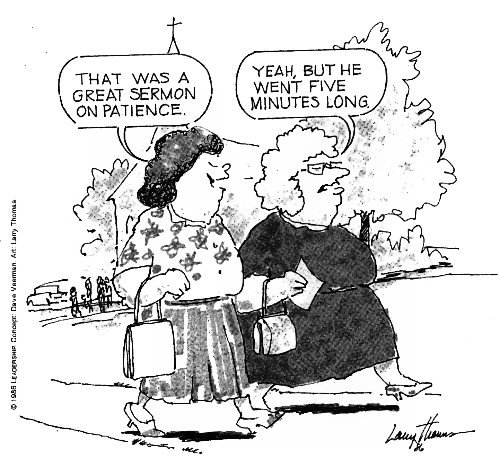
Hearing and Practicing Patience


Dave Veerman and Larry Thomas
The Best Cartoons from Leadership Journal, Vol. 1 Posted by Picasa